
2025 Vintage Summary: Resilience Takes Center Stage
I usually prepare an annual vintage summary in December, but life and competing demands got in the way. After an extended holiday filled with family visits, we watched the U.S. government invade Venezuela and Minneapolis and threaten Greenland. Suddenly, the operations of a small farm in Davidsonville seem insignificant.
But times like these also remind us of the importance of strong, resilient communities, whether they are based in nature, semi-natural like our vineyard, or centered on human connections.
I usually prepare an annual vintage summary in December, but life and competing demands got in the way. After an extended holiday filled with family visits, we watched the U.S. government invade Venezuela and Minneapolis and threaten Greenland. Suddenly, the operations of a small farm in Davidsonville seem insignificant.
But times like these also remind us of the importance of strong, resilient communities, whether they are based in nature, semi-natural like our vineyard, or centered on human connections.
Nature has much to teach us about how communities of organisms work together to mitigate the impacts of natural disasters, pollution, and invasive species. We learned a lot about resilience in 2025; here is my vintage report.
Extreme Drought and then Rain Start the Season
The 2025 vintage was marked by winter drought, months of heavy spring rain, then drought again, equipment failures, the Spotted Lanternfly invasion, and ongoing learning from our experiences.
On April 10, just around budbreak, the U.S. Department of Agriculture declared Anne Arundel County a federal disaster area due to several years of drought. The aquifer was lower than ever recorded.
Almost on cue, the drought started to ease. We were happy to get some rain, which increased nutrient turnover as the vines and cover crops emerged from winter dormancy.
By May, however, the rainfall became excessive, with 11.5 inches that month, 10 inches in June, and 6 more in the first half of July. On Friday, June 13, alone, an incredible 5 inches fell in just an hour and fifteen minutes.
Several effects are anticipated from this heavy rainfall during the first half of the growing season. First, the soil would become waterlogged, with mud puddles forming in low spots throughout the vineyard and heavy compaction from tractor passes. The vines' roots would become starved for oxygen, reducing their ability to absorb nutrients, resist pests, and set fruit, which limits the harvest size and quality. Additionally, the excessive water would create ideal conditions for fungal diseases, including bunch rot and downy mildew.
Yet, here at Dodon, none of this occurred. There were no puddles. The vines kept growing, even as many of our colleagues across the region reported yields 50-80% below normal at harvest. In fact, we experienced our second-largest harvest ever. Despite the tough conditions, we even managed to reduce pesticide applications compared to the 2024 vintage, which had much better conditions.
While I can’t prove it, I like to believe that the resilience seen in the vineyard comes from our farming practices-practices that rebuild soil health and restore functioning ecosystems. This experience aligns with emerging science that shows an extraordinary connection between biodiversity and resistance to extreme weather events.
The mechanism behind these benefits is straightforward. Different plants with varying root depths break up “plow-pan,” compacted soil that blocks rainwater infiltration, and create pathways that improve infiltration. Years of building a diverse soil microbiome create disease-suppressive soils that act as the vineyard's immune system, a function that now extends to control of insect pests.
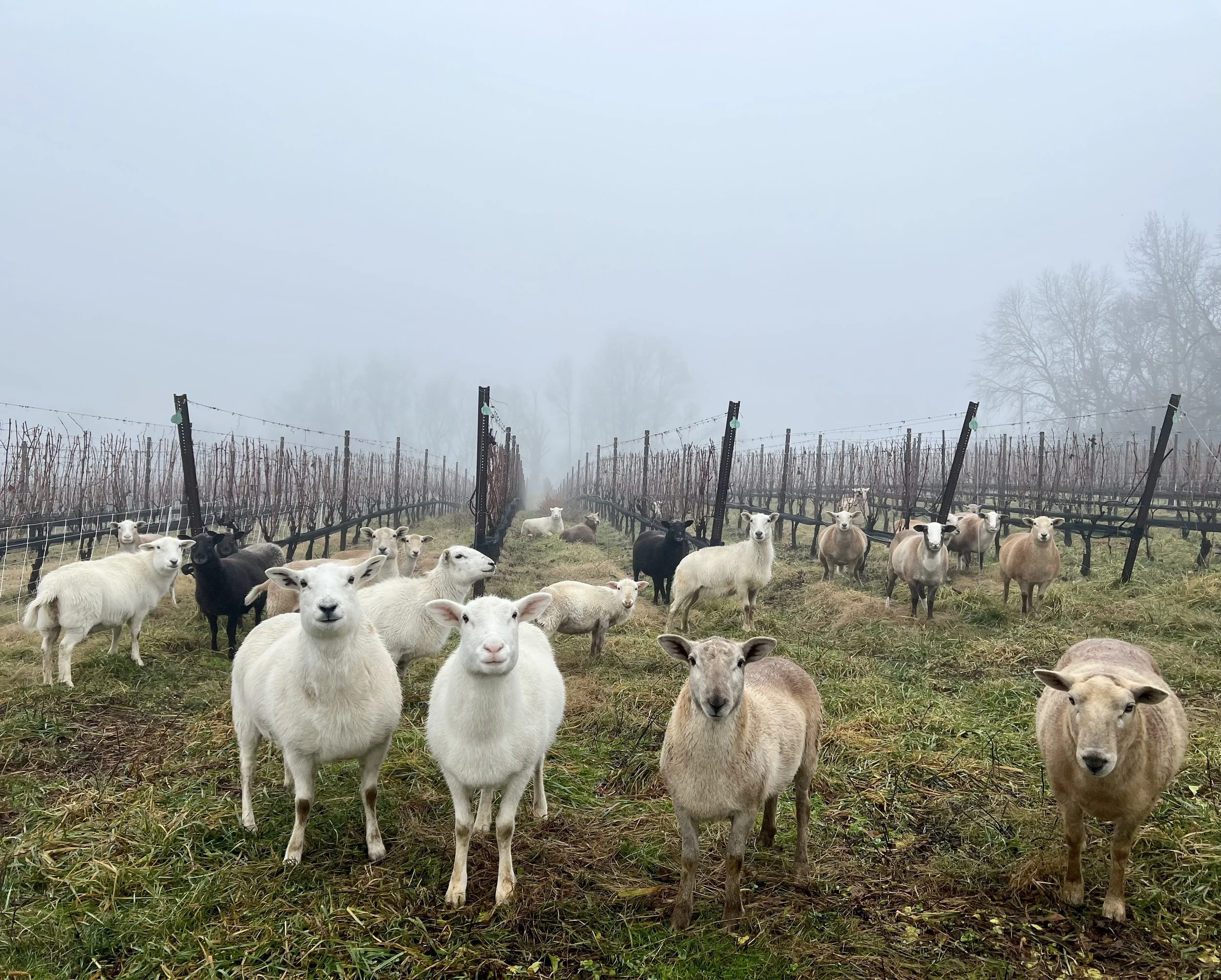
Simply put, we’ve confirmed that a healthy environment—one with diverse plant, insect, mammalian, and microbial life—helps create strong, vibrant, and resilient vines that resist all but the most extreme conditions.
Nature Heals Itself, But Can It Also Fix the Tractor?
In late April, we arrived to find the glass on a tractor door had shattered. To this day, we don’t know how or why this happened. Vandalism seems like the most likely cause, but we simply don’t know.
Replacing the glass was a quick and easy process, causing only a few days of inconvenience. However, a few weeks later, the engine of the other tractor caught fire while Kurtis was spraying. Roberto and Kurtis quickly took control of a truly dangerous situation, putting out the fire and stopping the engine by pulling the battery cable.
This time, the disruption was more severe. It took months to get the required parts. Our mechanic is also a busy farmer who needed to put up hay before the next rain. We quickly fell behind on essential vineyard chores, including crimping, tilling, and hedging. Being without one tractor meant hours spent changing implements and counterweights whenever we needed to finish a specific task. The vineyard team eagerly stepped in, working extra hours and doing as much as possible by hand.
The apparent cause of the fire can be linked to biodiversity loss, climate change, and malfunctioning ecosystems. Mice chewing on the wiring harness caused overheating, which was likely the main reason for the fire. This isn’t a new problem.
Over the past few years, we’ve had more rodents than usual around the farm. A year ago, they chewed through the truck's fuel line. An increase in rodents in the meadows has also led to more ticks than we’re used to.
The rise in mouse populations, as it turns out, is caused by changes in the ecosystem. You’ve probably heard the phrase “follow the money," but in nature, we “follow the food.” Bird populations, including raptors that keep rodent numbers in check, have decreased significantly over the past century. Warming temperatures, habitat destruction, and the reintroduction of coyotes have disrupted food chains, migration patterns, and reproduction, leading to a surge in rodent numbers.
At the same time, we’ve enhanced plant and insect diversity in and around the vineyards, providing more food and habitat for rodents. Essentially, we’ve increased the availability of rodent food while removing their natural predators, a clear example of a trophic cascade in action.
Tractor fires, fuel line leaks, and more ticks around the meadows are the result. For now, our response is to add more bat and hawk boxes, which we hope will help rebalance the ecosystem and keep the tractor running smoothly.
Redundancy to the Rescue
Narrow escapes marked the first part of the season. We endured the rain and still had a full, high-quality crop. We repaired the tractor in time to hedge before hanging the bird nets. Then came the final days of harvest, along with Spotted Lanternfly, a broken motor on the sorting table, and finally, a destemmer that wouldn’t start.
Broken equipment at the end of the growing season is common on a farm, but we work hard to ensure that the crush goes smoothly. Forty-two tons of ripe fruit need to be processed quickly and efficiently. Every tool, from the snips to the press, is serviced, checked, cleaned, and regularly inspected.
Yet just a few tons into the red crush, the sorting table started to wobble. One of the two vibrating motors had shut down. We checked the wiring, getting shocked a few times as we found that a ground wire was connected in the wrong spot. We tried to order a new motor, but it would take months to arrive from Italy. In the end, we jury-rigged the table to run on one motor — a little awkward and slow, but still workable.
The last day of the crush was expected to be lighter, with only three tons more, so we took an extra half-hour to sleep in. Everything appeared normal, and the team was relaxed and happy, until I flipped the destemmer switch. Nothing. After two hours of troubleshooting and several calls to the manufacturer, still nothing.
Fortunately, we had our old destemmer in storage. Out it came, and soon cleaned, sanitized, and ready to use. It runs at about a quarter of the speed of the broken one, but at least it runs.
Just like with the tractor, having a spare showed that redundancy can be a crucial part of resilience. When I shared this story with a Navy submarine commander several months later, he immediately understood what I meant. On a submarine, where broken parts can mean life or death, they keep as many as eighteen replacement parts for each system.
SLF Finally Arrives
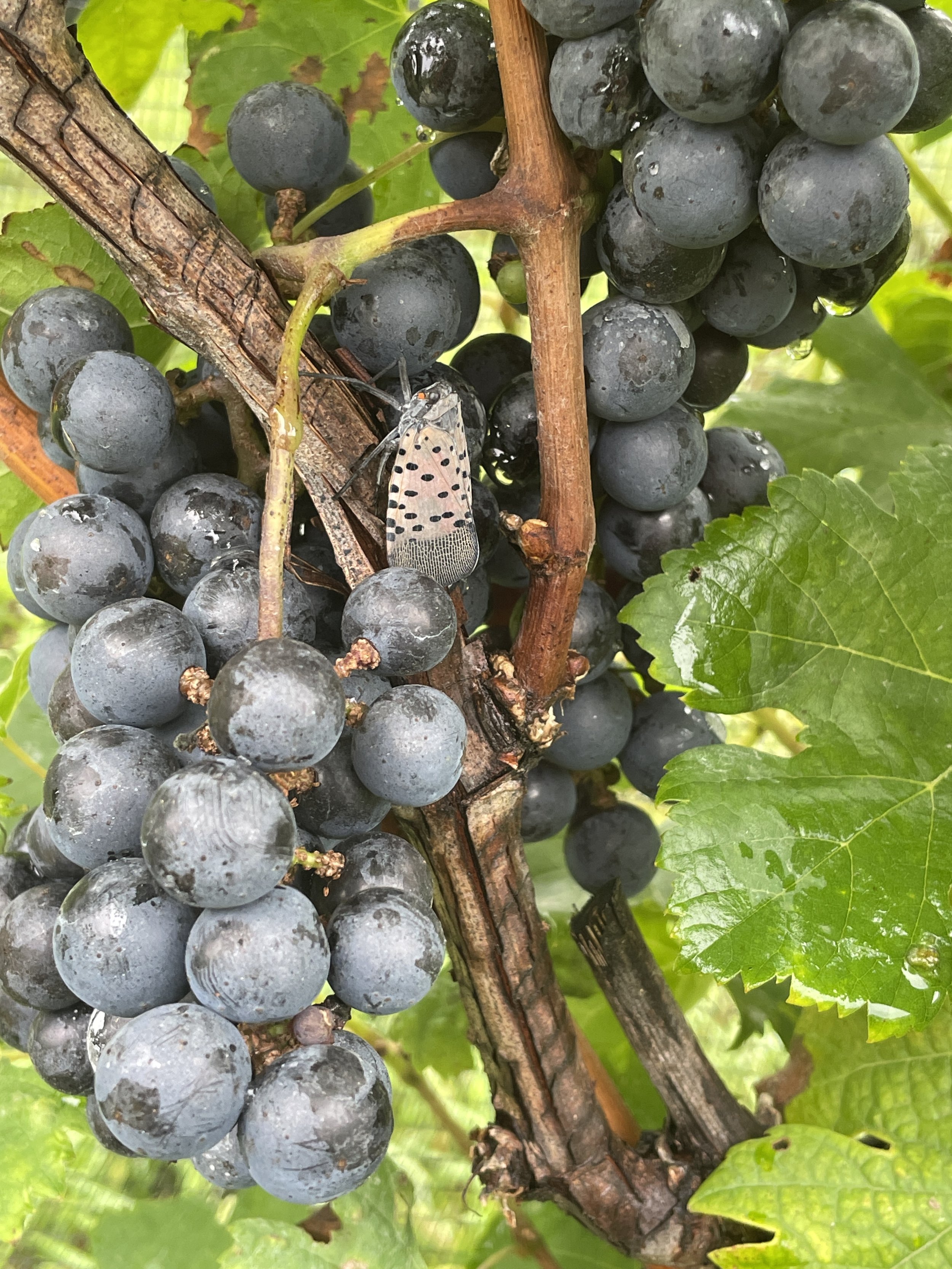
We have known for years that the Spotted Lanternfly (SLF) would arrive. We prepared by removing hundreds of Ailanthus altissima, also known as the Tree of Heaven (TOH), which attracts SLF and enhances its reproductive ability and lifespan. We also installed songbird and bat boxes to attract natural predators. These efforts yielded only limited success.
By mid-summer, many of the Ailanthus we killed a year ago had grown vigorous new shoots. These sprouts had attracted large numbers of SLF. At this point, I felt we had no choice but to use pesticides—an herbicide to eliminate the Ailanthus and a long-lasting insecticide to reduce the SLF population. Like in medicine and public health, sometimes targeted treatments are necessary when cultural practices fall short.
We hoped that reducing the number of SLF near the vineyard would decrease their population within the vineyard. However, we started noticing adult SLF in the vineyard in early August, though there were very few until Regina spotted three on a single shoot in Row 3 of Block 40, the first red block to be harvested. The next day, the first three rows were covered. Since the fruit had already been harvested, we decided to apply a long-acting insecticide by hand to these rows alone. The number of SLF per vine we observed would likely weaken their ability to survive the winter.
And so, the rest of the fall passed. An infestation would appear—some large, some small, but almost always on the outer edges of the vineyard—that we would treat. We had two goals: first, to prevent excessive feeding that would weaken the vines enough to prevent them from surviving the winter; second, to reduce egg laying in the vineyard.
We don’t yet know the results of our efforts. It seems likely that the insecticide reduced their numbers, but many egg masses remained in early November. When I surveyed areas with a high concentration of Ailanthus in nearby woods, I found very few SLF, suggesting that the insects probably flew into the vineyard from elsewhere. In other words, while adding bat boxes and birdhouses may help, unless they are used throughout the community and unless host trees for miles around are removed, we are likely to continue seeing SLF in the vineyard. These measures will only have a major impact if implemented community-wide.
Team Updates
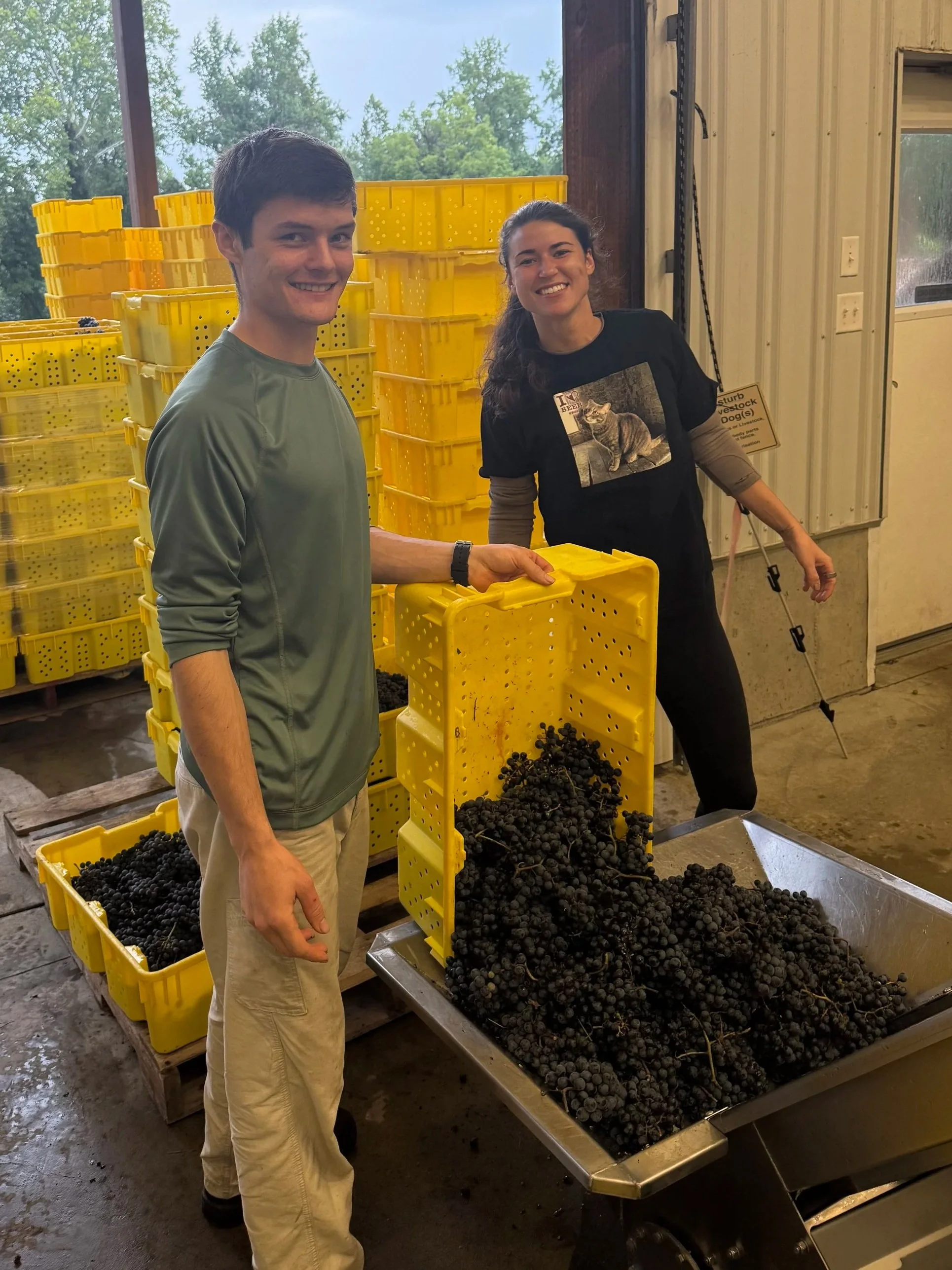
Some moments are bittersweet. After years of a long-distance relationship, Operations Manager Katie Sircovics will join her husband, JJ, at Fort Bragg later this month. It’s been wonderful to watch her grow both personally and professionally, and we’re glad to celebrate this joyful milestone in her life.
I have so many great things to say about Katie – her practical solutions when we overcomplicate things, her willingness to take on any task to be helpful, and her dedication to Dodon’s mission. But mostly, I’ll miss her delightful presence.
Fortunately, Katie will continue as Dodon’s operations manager, working remotely except during harvest, when she’ll return to the crush pad to assist Kurtis in the cellar and support the front-of-house team during the busiest part of the season.
We’re excited to welcome Jen Daszczyszak (pronounced datz-a-shock) to the full-time team as the wine club manager. Jen joins us from the Clarice Smith Performing Arts Center at the University of Maryland, where she managed the costume shop and was recognized in 2024 for new ideas that embody the spirit of moving Fearlessly Forward with innovative and creative thinking. Jen is also a self-described “wine nerd.” Many of you will recognize Jen as a wonderful host and tour guide, having served on Dodon’s part-time team for several years.
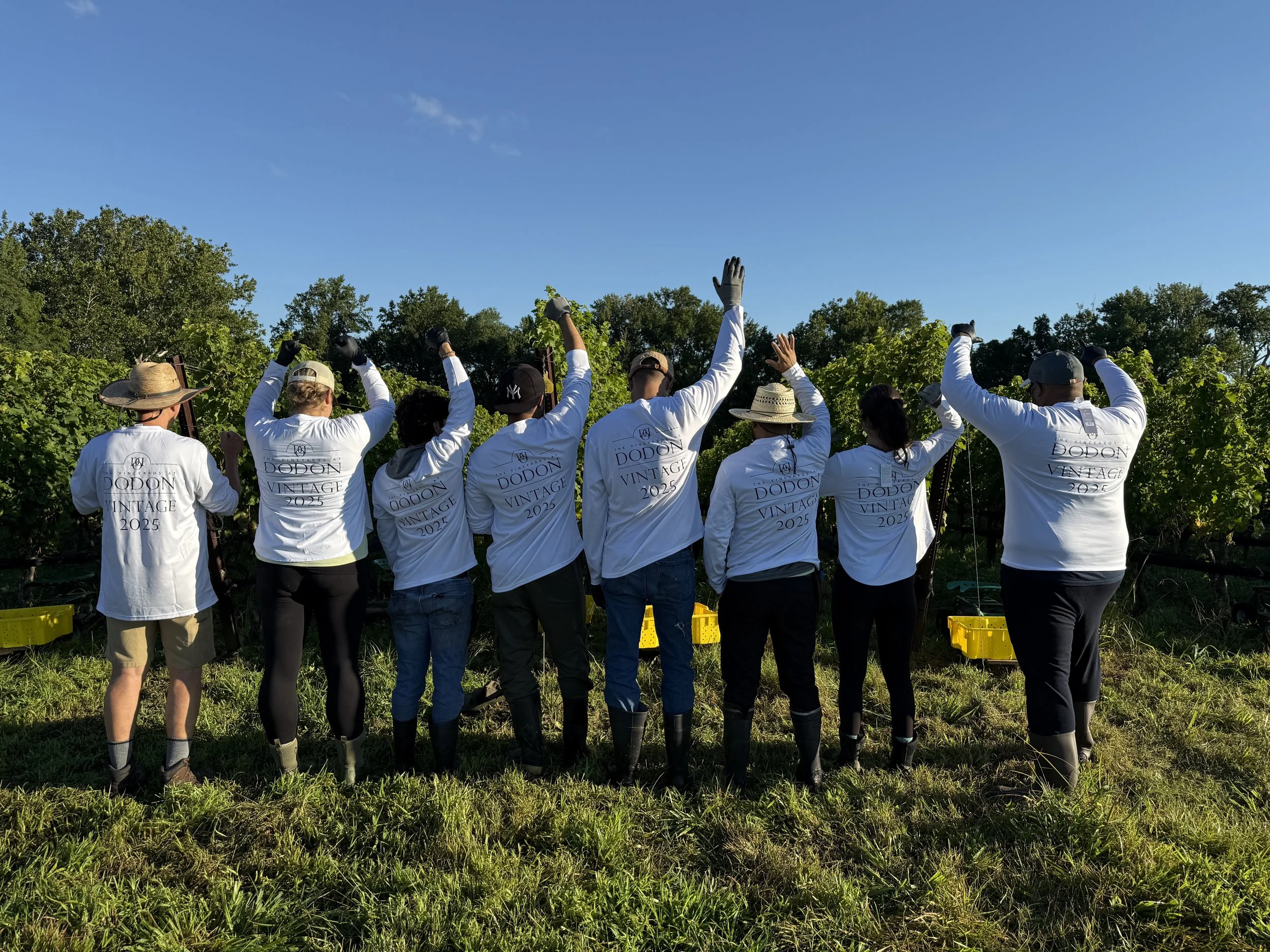
New Activities
The new farming operations, which we call “The Gardens at Dodon,” are underway, with new fencing, clearing invasive species for the food forest, and apple trees growing in the nursery. We appreciate receiving a planning grant from the U.S. Department of Agriculture to explore the feasibility of the food forest, expanded silvopasture, apple orchard, and vegetable projects. Our goals are complex, balancing the financial sustainability of historically low-margin businesses with our community, environmental, and justice objectives, so that a robust business plan will be crucial.
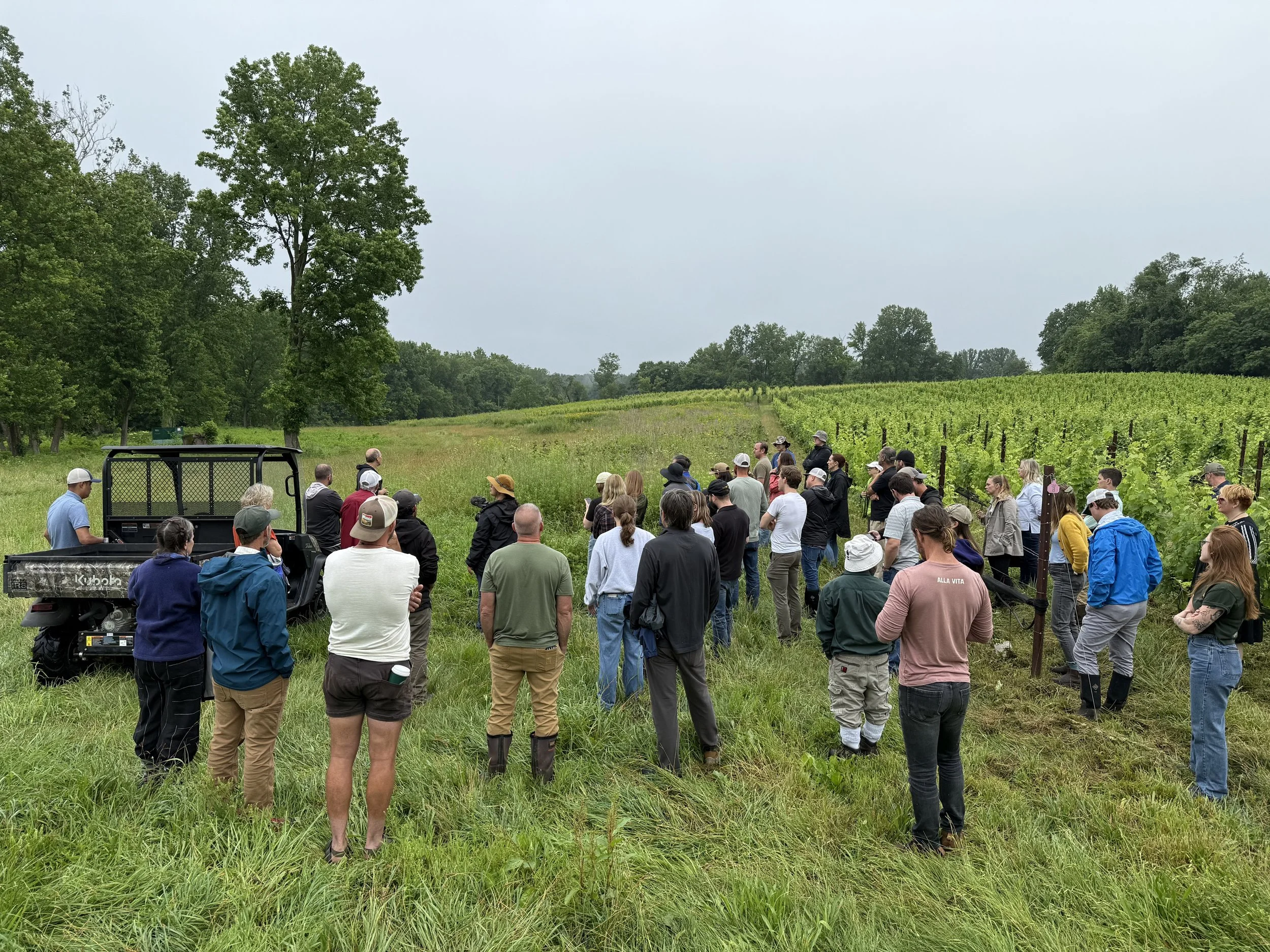
Polly and I are especially excited about the Dodon Center for Ecological Farming. We held a very successful “soft” start in June with a workshop on regenerative viticulture with our partners Kelly Mulville and Elaine Patrini from Paicines Ranch in California. In July, we convened the Board of Directors, which approved the Center's Mission and Vision statements and offered strategic input on several ambitious projects, including a workshop for congressional staff in collaboration with the Climate Farm School, now scheduled for May 2027.
What Nature Teaches Us
I began this essay reflecting on how nature can teach us about resilience, symbiosis, and functioning communities. Even plants, which we often see as passive because they are anchored in one place, are active members of their ecosystems. For example, when a pollinator approaches, plants sense the vibrations of fluttering wings and release just the right amount of pollen. In a sense, they anticipate the upcoming visit, just as we might prepare for a dinner party.
Plants also distinguish between the friendly sounds of a butterfly and the threatening noises of a pest. When a sharpshooter, a type of leafhopper that spreads Pierce’s Disease, gets close, grapevines release chemical distress signals. Some of these signals travel through the plant’s vascular system to the roots, where interaction with microbes greatly enhances the plant's defenses. The plant also releases volatile chemicals into the air, alerting its neighbors about the impending threat and attracting natural predators of the sharpshooter.
Walking down a vineyard row, whether we perceive it or not, we are immersed in this sea of plant volatiles. The vines are communicating their emotions to us, too. If only we could train our senses to listen to their signals, it might change our understanding of life and our role in nature. As author Zoe Schlanger asks in her remarkable book, The Light Eaters, “What if the lovely aroma of a freshly mown lawn represents the screams of grass?”
Of course, not all plants, even those of the same species, respond to threats in exactly the same way. Some react strongly, releasing large quantities of volatile chemicals, while others are more subdued. It’s as if the plants have unique personalities, all of which are necessary for the health of the population. Since they all play a role, if one of the personality types is removed from the environment, the entire population collapses. It turns out that in nature, life relies on diversity, a lesson that our human leaders would do well to learn.
And Finally, a Musical Theme for the Season
As always, I offer a musical theme for the vintage. Composed during the Gilded Age, Mahler’s Symphony No. 2, known as The Resurrection Symphony, takes us from a funeral through various stages of grief in the first four movements to a sense of eternal renewal in the fifth, where Mahler reproduces a portion of Klopstock’s poem, "Die Auferstehung."
Rise again, yes, rise again,
Will you, my dust, after a brief rest!
Immortal life! Immortal life
Will he who called you, give you.
The Gilded Age bears striking similarities to today. It was a time of rapid technological change, wealth accumulation, and political power by the rich, but it was also marked by rising income inequality, environmental damage, and worker unrest, eventually giving way to the Progressive Era. Mahler’s symphony reminds me that whether the ecosystem is damaged environmentally or socially, the future can be hopeful if we have a clear vision of what it could become. I hope that Dodon will serve as this visible example of what a just, ecological future can look like, if, as Ayana Elizabeth Johnson reminds us, “we get it right.”
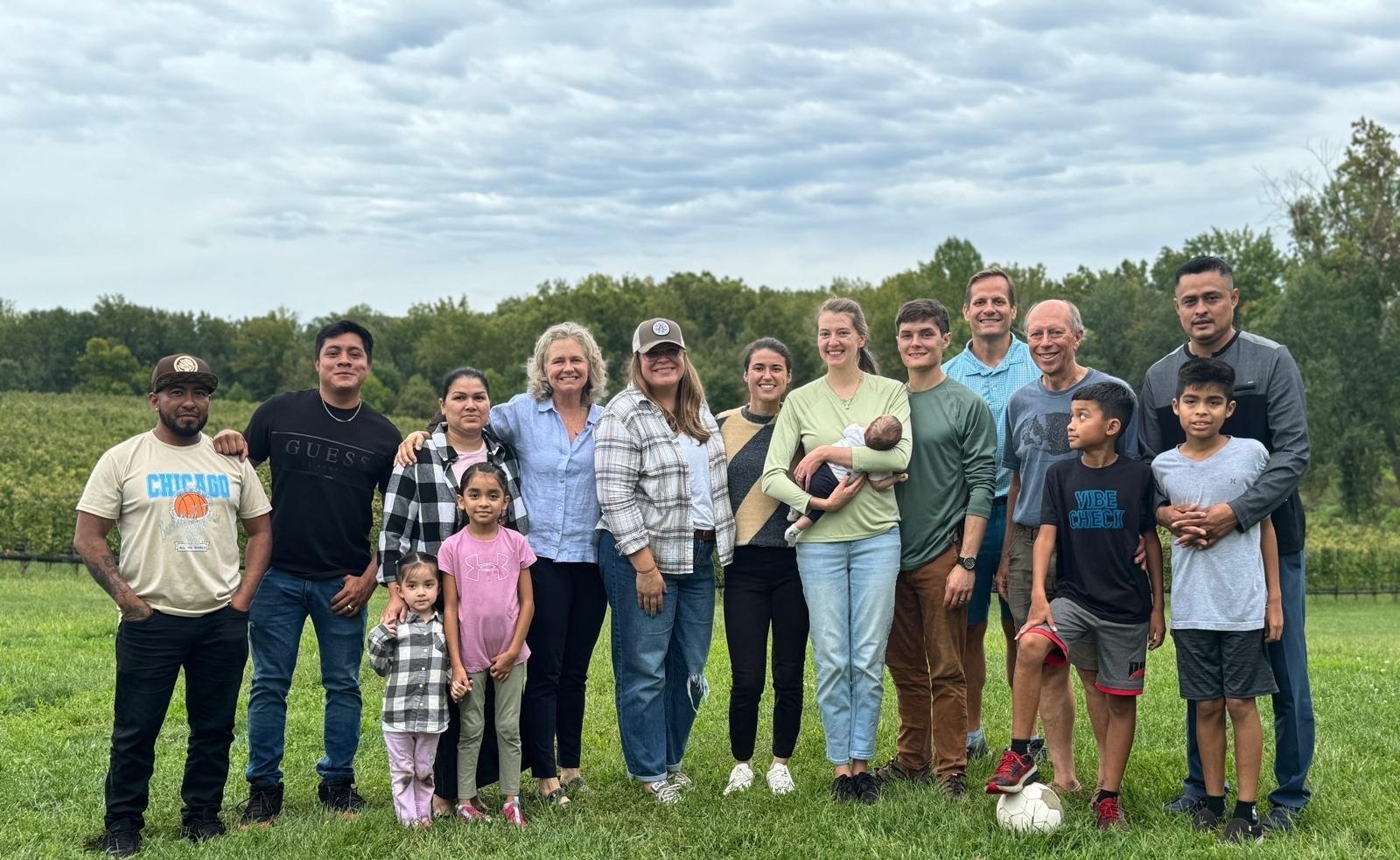
2024 Vintage in Review
Just as we aim to farm in the service of nature, we seek to farm in the service of our community. In the spirit of reporting to our community “shareholders,” I offer this 2024 review. It’s lengthy, but there is much to report: a fantastic harvest, widespread recognition of our environmental approach, and the slow emergence of plans for our next chapter.
Happy New Year 2025!

Co-owners Tom Croghan & Polly Pittman
Just as we aim to farm in the service of nature, we seek to farm in the service of our community. In the spirit of reporting to our community “shareholders,” I offer this 2024 review. It’s lengthy, but there is much to report: a fantastic harvest, widespread recognition of our environmental approach, and the slow emergence of plans for our next chapter.
2024 Vintage in Review
Most vintages in the mid-Atlantic are a struggle, characterized by too much or too little rain, late frost, and excess humidity. The most recent season wasn’t one of them; we had a spectacular vintage.
After a very wet winter, the mostly dry season offered the calm, smooth rhythm we hope for (but never plan for). With plenty of chill hours, bud break began mid-April at 76-degree days, marking the first time since 2021 that vine phenology was in sync with the rest of the ecosystem. Over the next few weeks, temperatures dipped below freezing four times, but the wind machines limited frost damage to small areas of the West Vineyard. Nature hinted at authority, keeping us alert and thoughtful, but we avoided crushing blows.
Nearly perfect bloom weather meant an excellent fruit set. Record hot, dry weather during June and July limited disease pressure and sped the march toward ripening. Veraison appeared on July 15, the earliest ever. Two inches of rain over the next week refreshed the vines, the cover crops, and their human tenders to make a solid push to harvest.
Nighttime temperatures also dropped as low as the mid-40s, rising into the 70s in the afternoon during mid-August and early September. This diurnal variation is perfect for ripening, slowing sugar accumulation and evaporation while promoting flavor and phenolic development.

Sauvignon Blanc grapes on their way to the press.
We started picking the Sauvignon Blanc on the north slope of the East Vineyard on August 26 and quickly moved through the remaining Sauvignon and Chardonnay, finishing on August 30. The Sauvignon Blanc acids and flavors held up admirably despite the excessive heat of the summer, making this vintage our best ever. The Chardonnay was somewhat less resilient but still excellent. We wish we had more volume, but the vines are recovering from three years of significant frost damage from 2020 through 2022.
After a week-long break, we leisurely picked 2.5 tons of Cabernet Franc from the swale in the South Vineyard. We took this fruit directly to the press and fermented it in stainless steel to make an exceptional Reserve Rosé, one of our most sought-after wines.
The vendanges peaked on Thursday, September 12, when an early nor’easter started moving up the east coast from Florida. The team harvested 23 tons in an extraordinary effort, picking from dawn to dusk over six days. The last fruit arrived on the crush pad at noon on Tuesday, September 17, one hour before thirteen days of rain began. Kurtis and Katie then wrapped up the season with two weeks of 16-hour days in the cellar.

Cabernet Franc hanging on the vine.

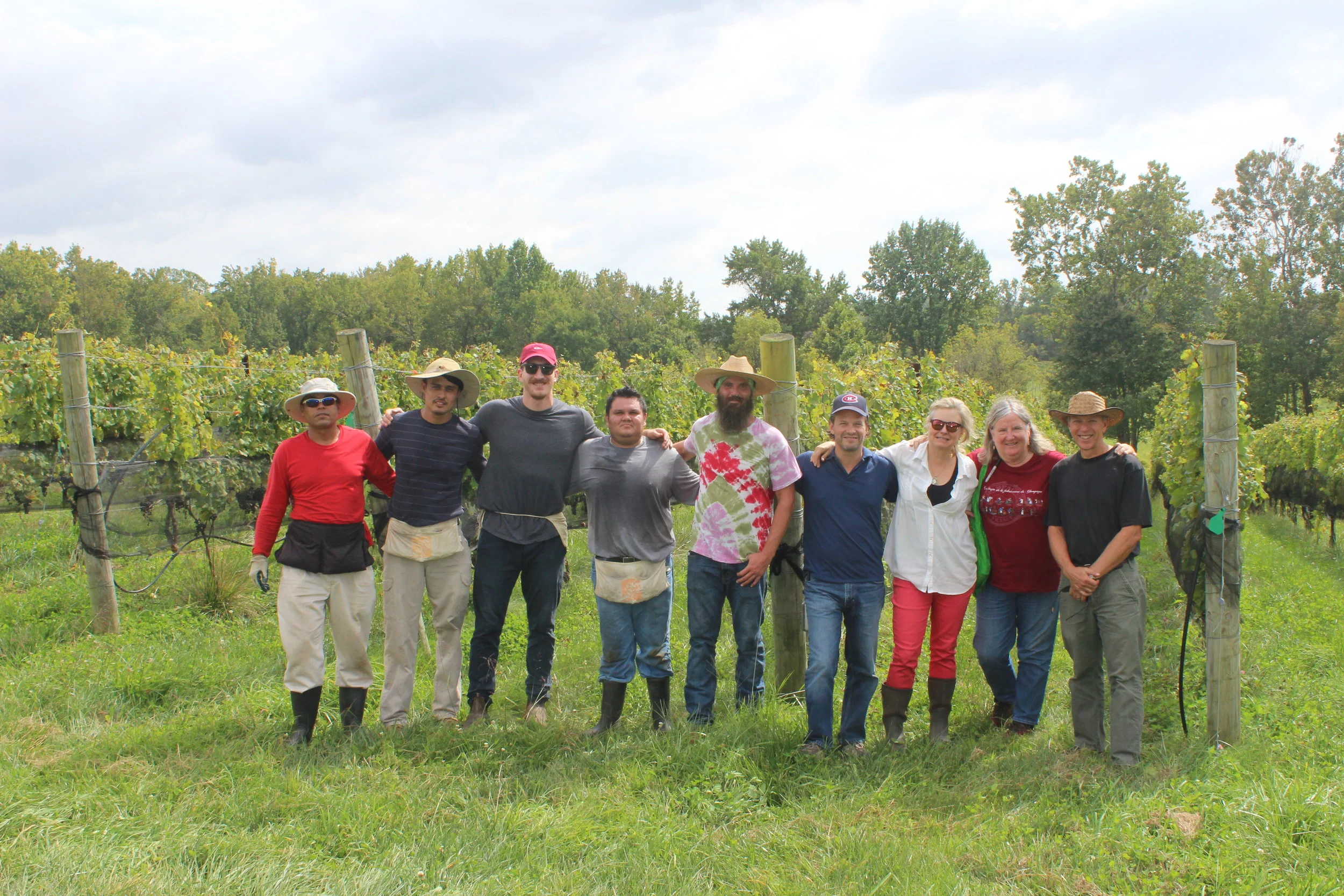
Part of the harvest team after the last block of grapes was picked.
Overall, we harvested 39 tons of outstanding fruit. While about 12% less than the 2023 vintage record, the balance and quality could not have been better. In many ways, the 2024 vintage demonstrates that luck is the confluence of preparation and opportunity. The vines tolerated the drought because of the increasing soil organic matter, the transition to Guyot Poussard pruning, and a knowledgeable, committed team willing to put the mission before themselves.
With the satisfaction of having outrun the rains, the 2024 vintage offered a happy break from the usual chaos of the growing season, evoking Johannes Linstead's Between Tears. It allowed us to stretch our skills in new ways, fusing a decade and a half of growing and winemaking experience with the complexity and diversity of the natural world to create the signature harmony, balance, and depth we seek. The result is perfectly summarized in Emmanuel Pahud and Jacky Terrasson’s elegant Aprés un Rêve (after a dream).

Thumbs up to a great vintage.
New Threats and Old
While it was a lovely vintage, it still brought worry. Two new threats arrived at Dodon this year. Both can devastate a vineyard and are typically treated with intense insecticide applications. In each case, we’ve opted for a different path.
Spotted Lanternfly, or SLF, is an invasive planthopper that feeds on sap, robbing the plant of essential nutrients. While it can feed on many trees, its preferred hosts are the invasive Ailanthus trees, also known as Tree-of-Heaven, and grapevines. Adults are active in August and September during the harvest, swarming into some vineyards by the millions. In many cases, wine quality is compromised. Sadly, in some instances, SLF takes enough nutrients that the vines cannot survive winter dormancy. One colleague in Pennsylvania lost 35 acres of vines early in the SLF epidemic.
Recent research has shown that birds and other SLF predators leave them alone when they have fed on Ailanthus but eat SLF when they feed on different plant species. We have thus aggressively eliminated Ailanthus trees around the vineyard, hoping that natural predators will substantially reduce the SLF population size. When we found adult SLF almost exclusively on dead or dying Ailanthus in August, we left them in anticipation of cutting down those trees in December, thus allowing us to eliminate any SLF egg masses laid in the upper branches.
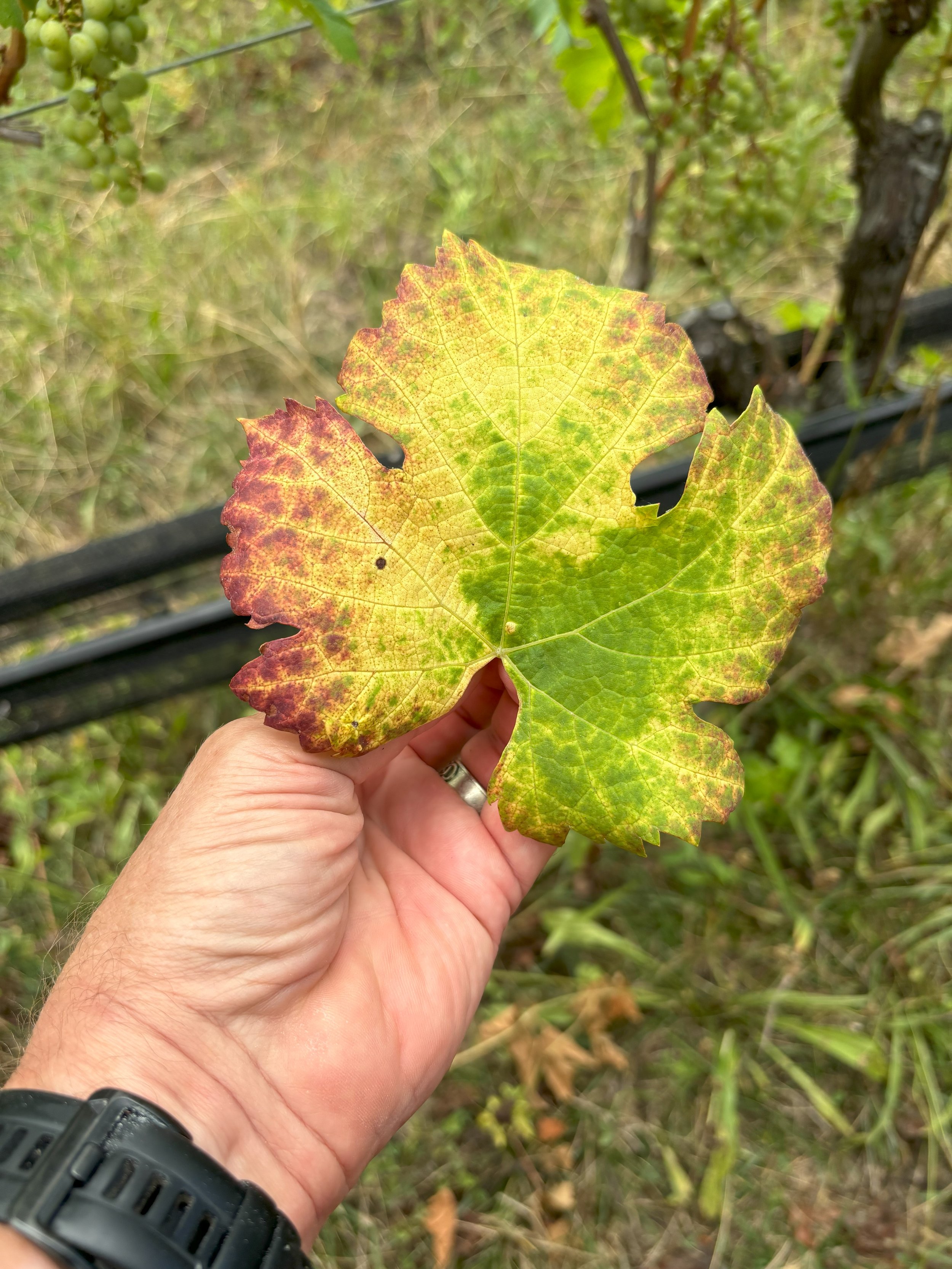
Discolored grape leaves can be a symptom of Pierce’s Disease.
We’re also taking a landscape approach to reduce the impact of another new arrival—Pierce’s Disease, or PD. PD is a bacterial infection caused by Xylella fastidiosa and spread by leafhoppers such as the broad-headed sharpshooter. Xylella and sharpshooters are commonly found in our region, but infection in grapevines has been controlled until recently by cold winters, which limited bacterial survival in the vines.
The conventional approach to treating established Xylella infections is vine removal and intensive insecticide applications during May and June when sharpshooters are active. But as my colleague Sam Droege of the U.S. Geological Survey’s Bee Lab reminds us, we can’t spray our way out of an endemic condition.
Just as with humans, the crucial step in controlling the consequences of any infection, in this case, Xylella, is to ensure healthy plants that are resilient to disease and the conditions that aggravate it. Xylella infects the xylem, the plant’s vascular structure that carries water and nutrients from the roots to other tissues. Plants with robust immune systems – for example, with plenty of phytonutrients like Vitamin C – living in healthy soil with aggregate structure to store water will tolerate infection. This is likely why we did not observe the typical signs of Pierce’s Disease until the extreme drought conditions of last summer, while many of our neighbors observed signs and symptoms much sooner.
As with Ailanthus, we are modifying the landscape outside the vineyard to reduce the spread of PD. Broad-headed sharpshooters prefer wetland habitats like the area that connects the South and East Vineyards. To make this area less hospitable to sharpshooters and Xylella, we’re removing invasive and dominant plant species, like mugwort, multiflora rose, and native grape vines, and replacing them with aromatic mints, such as bergamot, elderberry, and willow. The result will benefit the environment and the vineyard while also providing edible plants that we plan to use for non-alcoholic beverages, herbal teas, and medicinal purposes.

Spotted Lanternfly found on Ailanthus tree trunk.
I want to recognize the Maryland Department of Agriculture’s Spotted Lanternfly division and the team from the Integrative Ecology Lab at Temple University for helping to scout and develop an eco-friendly approach to what could be a damaging SLF infestation. We also thank Sam Droege and my colleagues Paulo Pereira and Emmanuel Bourguignon from the Living Vineyards project for their help envisioning the wetland restoration project.
For most sectors, environmental challenges loom on the horizon. But for wine growers, they are here. One example is the recent story of our colleague Stephen Cronk and his wife, Jeany. They sold their Information Technology business in London and moved to a Provence vineyard. Since purchasing the property west of St. Tropez in 2019, they've contended with severe frost and wildfires. (If you look through the charred timbers in the linked picture, you can see how close a 2021 fire came to their home.)
Stephen recently sent even more devastating news about their “nightmare” 2024 vintage, including frost, hail, rain during the harvest, flooding, and mudslides resulting from wildfire-induced vegetation loss in the hills that abut the vineyard. Stephen’s vintage summary for the Regenerative Viticulture Foundation, an organization he founded in response to concerns about his property's resilience, is included in RVF’s December newsletter.
In the Anthropocene, every region and every person faces new climate risks every year.
Other News

Hannah, Eleanor & Kurtis celebrate the end of a busy harvest season!
Babies and Such: On the human front, we were thrilled that, right after the summer bottling, Dodon team members Kurtis and Hannah welcomed their first child, daughter Eleanor. Kurtis was back by harvest, ready to lead the cellar work. Then, as we settled the last 2024 red wines into their barrels for the élevage, my son, Ian, and his wife, Michaela, welcomed their son, Kepler. Both babies are happy and healthy, bringing us additional joy. In between, Katie and JJ got married.
White House Initiative: In June, we joined the White House’s America the Beautiful Freshwater Challenge, becoming the first vineyard operation in the United States to do so. Led by Sara Gonzalez-Rothi, Senior Director for Water Quality (and a Dodon wine club member!), this partnership of 235 organizations seeks to preserve and restore freshwater ecosystems that provide us with food and water, protect our community from floods and storms, and offer a source of recreation and beauty. We are honored to be part of this extraordinary group of committed environmental leaders.
Wine Enthusiast Nomination: In September, Wine Enthusiast magazine announced that Dodon was among five nominees for its American Winery of the Year Award. As a relative newcomer, being included among legendary Napa Valley wineries like Schramsberg Vineyards is humbling. The winner, La Crema, is owned by the Jackson Family, founders of the International Wineries for Climate Action with Familia Torres. Jackson Family participates in the Porto Protocol’s Living Vineyards project, which I help lead. We salute the Jackson Family team and their work to ensure a better environment.
While our nomination was nominally related to our sustainability practices, as highlighted by Civil Eats, it truly reflects the team's commitment, dedication, and passion. Regina creates the collective effervescence that unifies a talented group to achieve shared goals that are collectively bigger than us. Katie’s critical thinking solves seemingly intractable challenges. Hannah’s grace, elegance, and wine knowledge make our service sparkle. Roberto’s persistence, enthusiasm, and devotion inspire all of us during summer’s dog days.
Promotion: Changes to the vineyard team have become a regular occurrence this time of year. I’m excited to announce that Kurtis will become Dodon’s winemaker in the new year. During his two years as Assistant Winemaker, Kurtis has demonstrated the initiative, determination, curiosity, and independence to take on this new role. He is also an extraordinary team player, eager to learn and contribute to all aspects of the business, including hospitality and financial management.
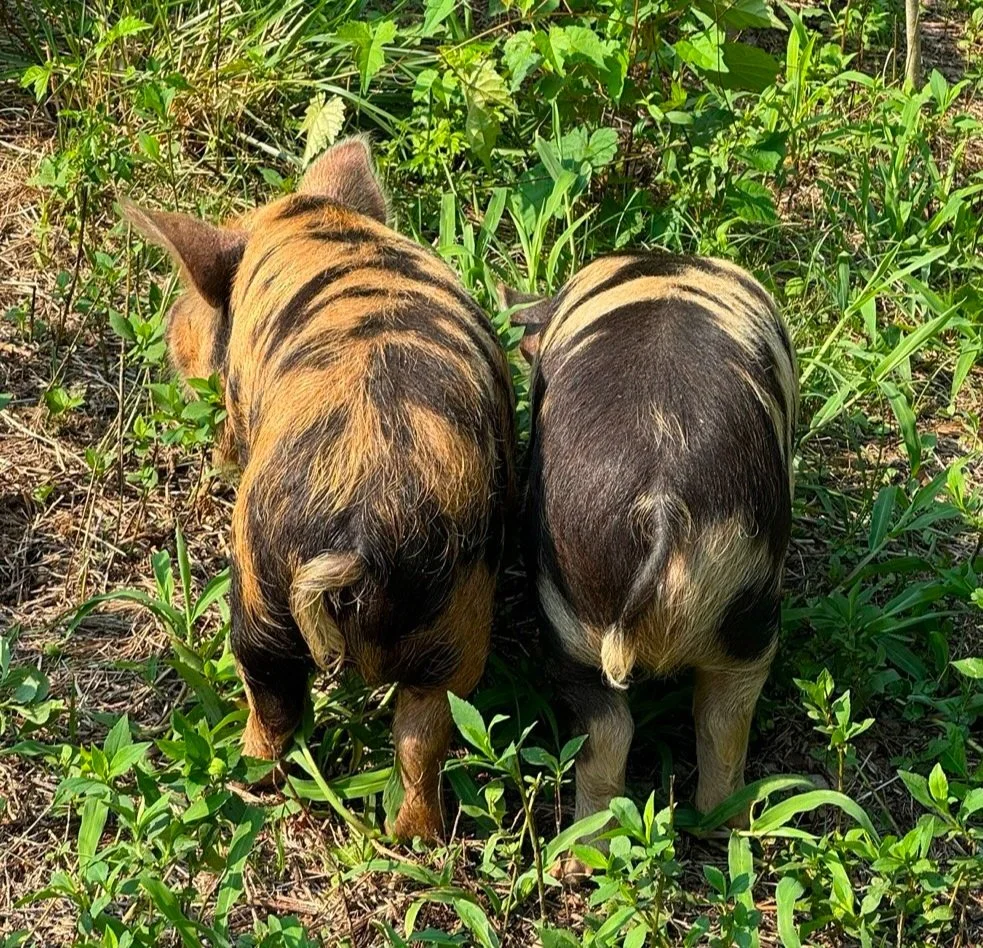
Couscous & Quinoa, Dodon’s KuneKune Vineyard pigs.
Pigs (yes, really): We’ve added Quinoa and Couscous, Kune Kune pigs from New Zealand, to the vineyard team. With weak neck muscles that prevent them from nibbling on leaves and fruit, Kune Kunes (pronounced Koonie Koonie, meaning “fat and round” in Māori) will graze the vineyard during the growing season to control weeds and add diversity to the soil microbiome, complementing the sheep droppings. Their short, upturned snouts also limit rooting and soil disturbance. And their gregarious disposition makes them great companions for the guard dog Willa, the ewes, and, of course, us humans!

New Evidence on Effectiveness of Agroecology: I have discussed our agroecological practices in a prior post, Farming in Service of Nature. At the time, these measures had solid experimental support, especially from the Jena Experiment, but their application in our vineyard was based mainly on intuition, listening to nature, and anecdotes. It’s reassuring that new research in real-life settings is validating our decisions. In a study in two Italian vineyards, researchers found that cover crop height is inversely proportional to fungal pathogen dispersal. A second study from Mendoza demonstrates the benefits of spontaneously growing grasses and forbs on carbon storage and biodiversity in row middles, albeit in a very different climate from Dodon’s.
Wine and Health: My past work in mental health policy has followed me into the world of wine. I have stepped down after a decade as Chair of the Maryland Wineries Association Government Affairs Committee. This year, I was asked to join the WineAmerica Board of Directors to advise the organization on health issues. Alcohol, in general, and wine, in particular, have complicated effects on health. Assessing these effects with any precision is difficult. I enjoy working on these kinds of questions.
In December, a committee convened by the National Academy of Science, Engineering, and Medicine released its most recent evidence review, which Felicity Carter nicely summarized in the trade press. Sadly, mainstream journalism has rejected the conclusions of the world’s most objective, apolitical, authoritative scientific body. Continuing to report that alcohol consumption in any amount is detrimental to health ignores the possibility that wine with dinner likely poses little risk for most people, and it may bring benefits to our health, which, as the World Health Organization reminds us, goes beyond disease prevention to include one’s wellbeing.
The Next Chapter
The wine industry may be at the forefront of the climate catastrophe, but all agriculture is approaching the firing line. According to the United Nations Food and Agriculture Organization report “State of the World’s Biodiversity for Food and Agriculture,” agriculture’s current industrial model is destroying itself and us with it. The report details the alarming damage to the biodiversity that sustains crop production. It describes our reliance on an increasingly small group of species, the destruction of habitat and land-clearing, and the unsustainable use of resources. And this is just the consequence of biodiversity loss. Extreme weather, drought, rising temperatures, and degraded soil add to the challenge.
The magnitude of the challenges ahead of us is daunting. The possibility of the food system collapsing is increasing, yet our political leaders have failed to act. Experts proposed a national food policy a decade ago. In 2019, the Eat Lancet Commission created a “planetary health” diet to reduce greenhouse gas emissions and improve health. Still, we have yet to produce a national or state food policy or to incorporate climate change into our national dietary guidelines.
Without political leadership, businesses and individuals are trying to implement the necessary changes. Doing so will be more complex and challenging than it should be without public leadership. Only the government can coordinate and finance an effort of this size and ensure the benefits and costs are equitably distributed. But, as Paul Hawken writes in The Ecology of Commerce, “The promise of business is to increase the well-being of humankind through service, creative invention, and ethical action.” We must still do our part.
At the Vineyard, the “triple aim” approach I proposed two years ago has served us well as a roadmap. Over the past decade, we’ve used the planetary boundaries framework to enhance biodiversity, reduce eutrophication and pollution, and remove carbon dioxide from the environment. We’ve been transparent when reporting our successes and failures.
In this context, we have begun to plan new farming operations to create a sustainable food source. While still in the early phase of the new project, which I call the “Do Your Part Initiative,” here are five key components of the vision that Polly and I have developed:
Converting the tree plantings to the north and east of the East Vineyard to a silvopasture that combines the benefits of trees and hedgerows with grazing.
Adapting the current grazing areas to silvopasture by planting 350 apple trees will also allow cider production.
Adding a “potager” or chef’s garden in the bowl between the winery and the South Vineyard will create what we hope will become a beautiful entrance to the winery that produces food.
Developing a “food forest” garden west of the Sauvignon Blanc blocks (West Vineyard), including picnic areas for our Wine Club Members.
Establishing a nonprofit “Learning Center” to provide apprenticeships for beginning farmers, bring together established fruit and vegetable producers to create new markets, and educate the public and policymakers about agroecology.
We would welcome your input as we continue to shape plans. We are most excited about crafting a vision of what a just, ecological society could look like. It’s doing our part.
As always, we are deeply grateful for your support. Happy New Year!


2022 Vintage Update: Doing Our Part
Every season, I’m dazzled that the buds break, shoots grow, inflorescences bloom, and fruit sets and ripens. It’s a bit like the sun coming up in the morning. Who can complain after that miracle? But some vintages are more successful than others. And despite the challenges, 2022 was more triumphant than most.
Sometimes the challenges around the vineyard seem insurmountable. In 2022, it started before bud break when the glass for our mid-March bottling was stuck on a ship in the Atlantic with no available port space. As a result, bottle costs nearly doubled as we scrambled to find replacements.
Shipping challenges also prevented the arrival of the new frost machines from California in time for bud break. The ensuing late spring frost killed half the primary buds on the Sauvignon and Chardonnay. Production of these wines was correspondingly reduced.
The warm winter disrupted vine phenology and ecological interdependencies. A foot of rain in August and Hurricane Ian heightened mildew pressure and diluted the wines. The precision electrostatic sprayer broke three times. We had powdery mildew in the Chardonnay blocks for the first time. Veraison was late, but harvest arrived quickly, with little time for sampling. Titratable acidity, a routine preharvest test, wasn’t measured. Neither was the yeast assimilable nitrogen, crucial to managing yeast nutrition during fermentation.
Disrupted supply chains remain a headache. We scheduled delivery of parts for the new destemmer to arrive in Baltimore in June. The ship reached the Chesapeake Bay in late October, long after harvest. Even then, it was redirected to Freeport, the Bahamas, again for lack of dock space. Our old destemmer, the one we, fortunately, hadn’t sold yet, didn’t start when I recommissioned it. Two members of the team had to isolate because of Covid-19 during harvest.
I was on edge throughout the season.
There Are No Bad Vintages
Every season, I’m dazzled that the buds break, shoots grow, inflorescences bloom, and fruit sets and ripens. It’s a bit like the sun coming up in the morning. Who can complain after that miracle? But some vintages are more successful than others. And despite the challenges, 2022 was more triumphant than most.

Some of the success was dumb luck. Red fruit yields were significantly larger than usual across the Mid-Atlantic region. Dodon was no exception. We picked more Merlot than we had tank space for, an excellent problem but one that required some ingenuity. The superb weather we had Memorial Day weekend resulted in high levels of fruit set. It made up for losing half the Sauvignon and Chardonnay to frost.
But preparation, planning, and hard work also contributed. July’s foot of rain reduced the phenolic levels below average, but the fruit was fully ripe and clean. The stormwater quickly infiltrated the vineyard floor. Despite the unusual occurrence of powdery mildew, we had very little downy mildew. While the good weather after veraison contributed, the benefits of our ecological farming practices are apparent.
And, of course, this success occurred with the tremendous effort of Dodon’s vineyard manager, Roberto Gomez, and his vineyard team. Facing the arrival of Hurricane Ian, the team regularly picked four and a half tons or more in the days preceding the storm, including 5.4 tons on the day Ian arrived. It was a truly heroic effort.
Transitions
Those of you who have been members of the wine club through the pandemic know the degree to which it forced us to change how we interact with you. As much as we enjoyed getting to know a broader slice of the community when we opened the vineyard to the public, it wasn’t us. We have neither the right place nor the disposition to be a raucous bar or restaurant. Instead, Dodon is a tranquil place to linger, converse, and enjoy nature.
We began transitioning back to tours, indoor seated tastings, dinners, and indoor and outdoor club member hours in 2022. It will hit full stride in 2023. Regina and the hospitality team will soon announce an exciting new year’s schedule, with more opportunities for private events and partnerships with wine shops, restaurants, and clubs.

Dodon’s hospitality manager, Katie Luscher, has successfully created a new food program that features offerings from some of our favorite local creameries, charcuterie makers, bakers, and other food artisans. You can look forward to enjoying this menu during wine club hours all year long.
We start the new year with some important staff changes. First, all of you in the Dodon Wine Club will be thrilled to hear that Regina has been promoted to General Manager. Simply put, she has earned our trust, respect, and admiration. Regina brings extraordinary commitment, thoughtfulness, and humanity to Dodon every day.
We welcome Kurtis Flaherty back to Dodon as Assistant Winemaker. A graduate of the Culinary Institute of America, Kurtis excelled as an intern at Dodon during the 2020 vintage. He then successfully honed his skills at The Wine Collective in Baltimore over the past two harvests. His dream has been to oversee an integrated vineyard and winery operation. Kurtis’ intellectual curiosity, executive skills, and attention to detail will ensure his success.
Of course, we are all sorry to see former Assistant Winemaker Seth McCombs leave Dodon for new ventures. His kindness, quick smile, and friendship taught us to be better people. We wish Seth and his family all the best in their next chapter.
Looking forward to 2023
Our challenges reflect the state of the world in which we live. Covid-19 continues to cause misery and, all too frequently, death here and abroad. The senseless, unprovoked war in Ukraine prolongs suffering and despair in that country, hunger in east Africa, and economic hardship here and in Europe. These problems also created the supply chain problems that were always around the corner in 2022.
Greed and an extractive economy degrade soil, destroy ecosystems, and accelerate the climate crisis that affects us in many ways. Hatred, intolerance, and exploitation prolong unnecessary prejudice, gun violence, poverty, and poor health. A dysfunctional political system delays meaningful progress in solving these and other problems, even when we know what to do. A healthy planet seems idealistic and naïve. Cataclysm has become plausible.
Doing Our Part
In many ways, I am fortunate to be a winemaker and thus on the front lines of some of world’s greatest challenges. The essential partners of our trade, the vines, sequester carbon and create healthy soil. The vines become healthier and yield more when they are part of a diverse, functioning ecosystem. Unlike most in our community, we have the opportunity, indeed the obligation, to reduce atmospheric carbon dioxide, not just slow emissions.

The extreme weather events and changing pest patterns, annual occurrences at Dodon, directly result from a rapidly changing climate. We could respond to them quickly by boosting the intensity and frequency of pesticide applications. But this short-term solution would also require tractor passes and more diesel fuel, kill beneficial insects, and reduce the diversity of the vineyard microbiome. In other words, farming in a conventional manner would contribute to the very problems that adversely affect us the most.
Instead, we look to nature for solutions. We seek healthy plants in a self-regulating system. Using the tools of agroecology, we build healthy soil, enhance biodiversity, and restore ecosystem function. Blending indigenous and traditional knowledge, we use diverse native cover crops to improve soil structure and create channels that allow stormwater to infiltrate deep into the subsoil. The sheep help build a diverse microbiome and enhance nutrient cycling. Adding crab meal to their winter ration reduces powdery mildew and eliminates tractor passes.
While we cannot solve the world’s problems alone, the Dodon team is determined to be a force for good in our community and the world. As we guide our small business through the zeitgeist of climate change, ecological degradation, economic disruption, and systemic racism, we promise to do our part to advance meaningful solutions and a more just, inclusive world.
So despite the trials of our operation, like many others, I’m entering 2023 remarkably upbeat, almost like a fog has lifted. It’s a toe-tapping type of optimism, the kind inspired by Aaron Copland’s “Hoe Down” from his ballet Rodeo. The challenges in the vineyard are daunting. Those faced by our species seem insurmountable. But there is a clear path to a bright future if we grab it.
As always, we thank you for being part of the Dodon community and wish you a happy and prosperous new year!

2020 Vintage Check-in
The year started normally enough. The autumn had been good to us. Warm weather, absent the extreme rain of 2018, meant healthy vines entered dormancy. We enthusiastically embraced new cover crops, created a novel composting program designed to stimulate mycorrhizal fungi, and bought a flail mower to mulch vine pruning wood in the vineyard.
The year started normally enough. The autumn had been good to us. Warm weather, absent the extreme rain of 2018, meant healthy vines entered dormancy. We enthusiastically embraced new cover crops, created a novel composting program designed to stimulate mycorrhizal fungi, and bought a flail mower to mulch vine pruning wood in the vineyard.

The front of house team was equally buoyant. We established new partnerships with restaurants throughout the region, negotiated with distributors who could expand our reach beyond the Baltimore/Washington/Annapolis triangle, and looked forward to enhancing our onsite hospitality.
We had even managed to find an exciting solution to the challenging 2018 red wines, partnering with our friends at McClintock Distilling to produce an interesting fortified wine that will, after aging in barrel for a few years, offer a delightful after-dinner alternative from Dodon.
The concerns for the upcoming vintage were either familiar – the winter was too warm - or seemingly distant – the expanding infestation of spotted lanternfly. We have learned to mitigate the detrimental effects of these threats. We were also poised to turn our first-ever profitable year. Even climate change and reports of a new viral pneumonia in China looked remote.
A Different World
The optimism that propelled us into 2020 now feels like a different world from the one we now inhabit.
The pandemic-related challenges that we face - revenue loss, higher expenses, the health of our employees and their families - across all segments of the operation are the same as those that face many similar small businesses. Despite these challenges, and sometimes because of them, there have been many rewarding moments.
Curbside pick-up, drive-through, and home delivery have been very popular. The largest source of revenue, about half, comes from these direct-to-consumer sales for off-premise consumption. It is enormously rewarding to think that the wines bring you pleasure, satisfaction, and fond memories. The entire team is very grateful for the response of our club members, which will allow us to make payroll and purchase essential supplies through the summer.
Our other sources of revenue – club hours, Dodon ‘til Dusk and other events, tours and tastings, and sales to restaurants and shops - have vanished. Although wine shops are still open, their sales tend to “big box” brands at the expense of small-production wineries like Dodon. After brisk sales in January and February, we have sold just three cases of wine to shops since then.

On the production side, we replanted 1,500 vines to replace those that have died over the past 10 years. The slow start to the season has given us extra time for under vine weed control, and we have added new native plant gardens around the winery. Two significant frost events have required additional shoot management. We do not yet know the full effects of the frost, but I estimate that white wine production will be a little less than half of what we projected. Red production, however, looks like it will be only slightly reduced.
Of late, there have been some darker burdens, apparently based on the mistaken belief that Polly’s brother, currently the Anne Arundel County Executive, owns the winery (he does not) or has made policy decisions to benefit us (he has not). Hoping that county businesses will open faster, a few people made hostile comments on a private Facebook page - threatening the vineyard with “a case of the roundup,” to “burn his [expletive] down,” to “turn [Annapolis] harbor into red wine,” and even “a dirt nap” - that frightened us. These comments also caught the attention of the police who have enhanced security for the farm.

Looking Forward, Staying Well
We do not know exactly what the future will hold. Drawing on my public health experience, Regina, Alley, Polly, and I conducted a “table-top” exercise to understand alternative scenarios and determine how the vineyard operation can keep going over the next few years no matter which occurs.
The least likely scenario - that the pandemic will end quickly, either spontaneously or from a medical magic bullet – would allow a return to business as usual sometime soon. All other scenarios involve some degree, large or small, of risk that will require careful planning. Above all else, we want our visitors to stay well and to feel safe when they visit. My disposition is to be overly cautious, not cavalier, this season.
Because the plants and animals continue to need tending, we first focused on the safety of Dodon’s production and front-of-house staff by updating our standard operating procedures with information on personal health and hygiene, maintaining a clean workplace, physical distancing, and shared tools and equipment. We have also hired additional vineyard staff to mitigate concerns that several of us could become ill or require quarantine or extended isolation.
Our next task is to meet the needs of club members. We plan to continue curbside operations, home delivery, and enhanced club discounts for the foreseeable future. Because we have plentiful outdoor space, our reopening plan has started there. Regina is finalizing procedures for extended club hours when we can have them.

While we have spent many hours reading and attending webinars to understand the appropriate safety procedures, we would be very grateful for your input on what you believe will give you confidence that you will be safe when you visit us. Please leave your ideas in the comment section or send an email to Regina. We will be publishing these plans very soon as it seems likely that outdoor dining and related activities will soon be allowed.
It is unlikely that Dodon will host this year any indoor events, including tours and tastings, dinners, or private gatherings, and we doubt that restaurants will fully recover quickly. In the long run, we will thus need to increase direct to consumer sales to keep going.
To accomplish this goal, we have set up a small studio in the Collectors Room for virtual tastings. Those who have participated in these seem to have enjoyed them tremendously. It is a wonderful way for friends and colleagues to gather and spend some time together, and it will help introduce Dodon to those who do not know us.
Beyond our own needs, Dodon is part of a larger community, one that has largely pulled together in mutual support during the pandemic. We recognize that while it has created challenges for us, many are having a much harder time than we are. We have thus offered to serve as a pick-up location for local farms that have also lost their restaurant markets, established a donation program, and extended club benefits to the hospital and food workers that have supported us.
How we interact with each other may be different this year, but the essence of the Dodon experience – warmth, rustic elegance, and impeccable service – will, we hope, be familiar to you when you visit. Like our annual dances with nature in the vineyard, curiosity, critical thinking, redundant systems, planning, and humility will sustain us.
From all of us, please be safe and stay well.
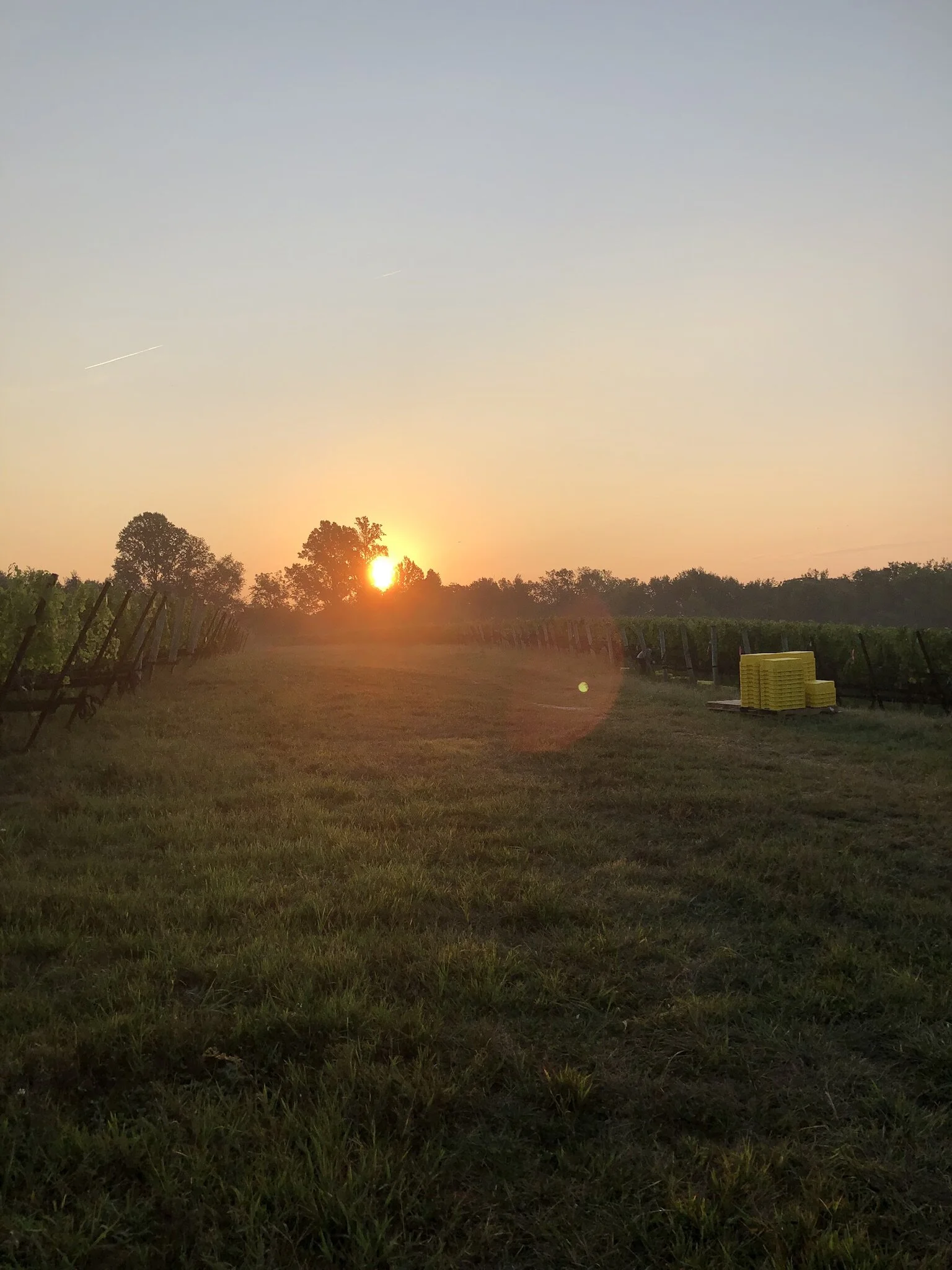
2019 Vintage Summary: Tranquility and Transformation
Things may have seemed simple in 2019, but they were not.
After the rains of 2018, the 2019 vintage brought welcomed change. Unusually dry weather that started in mid-July helped make the harvest, at first blush, delightfully simple. The vines politely stopped growing at veraison, focusing their energy on ripening the fruit. The vineyard team was, well, in the vineyard, the work progressing quickly and efficiently. Picking, sorting, and processing seemed almost effortless. The wines made themselves.
Things may have seemed simple in 2019, but they were not.
After the rains of 2018, the 2019 vintage brought welcomed change. Unusually dry weather that started in mid-July helped make the harvest, at first blush, delightfully simple. The vines politely stopped growing at veraison, focusing their energy on ripening the fruit. The vineyard team was, well, in the vineyard, the work progressing quickly and efficiently. Picking, sorting, and processing seemed almost effortless. The wines made themselves.

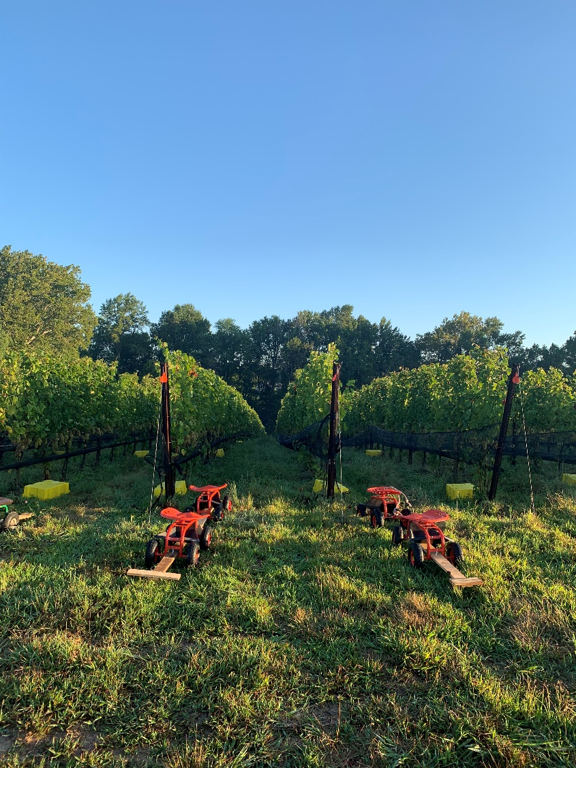

Club events were equally agreeable. The dry ground meant we could use the new parking area without preparing for towing duty. Dodon ‘til Dusk wasn’t canceled for rain, and Alley and her mostly new service team did a remarkable job learning their roles, revising procedures to enhance the DtD experience, and making all of us feel at home.
But underlying the triumphs were hidden challenges. The 2018 growing season - with its heavy precipitation, saturated soil, early defoliation, and poor nutrient storage - had lingering effects. In 2019, canes, buds, and the vineyard floor still contained high levels of residual fungal pathogens. Average low temperatures were higher than normal, limiting the number of “chill hours” (the number of hours the vines are exposed to temperatures between 32 degrees and 45 degrees F) that are required to break dormancy. The consequences were bud failure, excessive shatter (when the new seeds are not fertilized), and isolated bunch rot in the period before harvest, despite the near-perfect weather.
Still, the vintage proved exceptional. Although yields were low, about 20% less than usual, the quality of the harvested fruit was outstanding. The wines are continuing their annual trend toward greater depth and complexity, consistent with the increasing age of the vines. These characteristics were enhanced by long maceration times, allowing us to extract the full range of flavors. The Sauvignon Blanc and Rosé will soon be bottled; we are thrilled with them.
Lessons Going Forward
For the past year and a half, we’ve focused on understanding why 2018 was so damaging and on how we can be better prepared for the future. Our path to greater resilience involves two courses of action. First, we need to become more flexible in our harvest and winemaking strategies, such as when to pick early and make Rosé, when to alter our usual extraction processes, and what to do when we get caught with less than perfect fruit. We now have written protocols with criteria for their use for each of these situations.
We are also making fundamental changes to our vineyard practices. Because of my background in medicine and immunology, as I read more about the underlying science, the central concepts have emerged with clarity. While our farming has always been at the forefront of sustainability, 2019 is the year we hastened the pace of Dodon’s ecological approach to farming.
Throughout the vintage, we invested heavily in a set of practices that focus on improving soil, enhancing biodiversity and ecosystem services, and enriching the health, vitality, and resilience of the plants. Many of the techniques that we’ve adopted are the natural extension of our past effort to mimic natural processes, but our new focus centers primarily on soil and soil biology.
Soil with structural integrity, a diverse microbiome, and high levels of organic matter carries out many vital functions. It provides essential support for plants, protects against both drought and flood, removes environmental toxins, and improves water quality. Particularly important in today’s world, soil stores large quantities of carbon – more than twice the amount found in the atmosphere. Putting more carbon in soil will play a crucial role in addressing the underlying cause of climate change.
Healthy soil is the result of the biological interaction between plants and microbes. Just like the microvilli of the human intestine, roots are the mechanism that plants use to take in nutrients. As in humans, a balanced diet is essential for plant health. The best diets come from rich topsoil with good nutrient and water holding capacity, characteristics that allow the plants to produce complex phytochemicals that improve their structural integrity and strength, promote disease resistance, and enhance flavor.
Microbes – protozoa, fungus, bacteria, and archea – play several crucial roles in healthy soil. First, they decompose organic matter and secrete organic acids that breakdown rocks, releasing nitrogen, phosphorous, sulfur, and other nutrients that can be absorbed by plants, and they enhance water regulation by producing glycoproteins that improve soil aggregates.

Roberto and Tom construct a Johnson-Su bioreactor, a type of static, aerobic composter.
Second, beneficial microbes compete with pathogens for nutrients, secrete antimicrobial compounds and lytic enzymes that inhibit pathogen growth, and boost plant systemic host defense by stimulating production of phytochemicals. The result is an environment known as disease-suppressive soil that protects plants from pathogens.
The devil, of course, is in the details. There isn’t a textbook on ecological vineyard systems that translates these concepts into methods to create healthy soil, and only a few peers in the industry have taken this approach. The closest techniques are those used in biodynamics, but the supporting science for this very specific set of practices isn’t yet well-developed. As a result, we looked instead to other agricultural, natural, and scientific systems – everything from forestry to paleopedology (the study of soils from past geological eras) – and to our own property, where native grape vines live and thrive in the woods, not the pastures.

Turnips have a deep taproot that breaks up compaction.
Reasoning that grape vines would likely be healthiest in a forest-like setting supported by nutrients and microbes that are common in that ecosystem, we decided to emphasize growth of diverse fungal species that prefer woody food sources. Our compost program now emphasizes wood chips, and we’ve constructed a static, aerobic composter inoculated with soil from the woods just outside the vineyard. We hope that this compost will contain native mycorrhizal fungus species that will interact with the vines to produces better soil, healthier plants, and better fruit.
Because different plants provide diverse nutrients to soil microbes, we’re also working to enhance plant diversity within the vineyard. One method is to use highly heterogeneous cover crops. Our mix this year included eleven different species of grasses and forbs. A custom-made roller crimper has helped as well. When perennial grasses are mowed, hormonal signals stimulate regrowth. In contrast, crimping tall grasses terminates their growth and allows other plant species to flourish. Crimping also provides a mulch layer, cooling the soil to provide a better environment for fungal growth.

Crimping enhances plant diversity and cools soil.
Will these methods work? The conventional wisdom that vines need to struggle to produce the best wine gives pause to many of our colleagues, but it does not convince me. It’s true that overly vigorous vines with abundant foliage produce wines that lack structure and taste “green” from too many methoxypyrazines. The question is whether this vigor is produced by healthy soil with high levels of organic matter, or whether it is more likely to occur in unhealthy soil exposed to excess mineral nitrogen and phosphorous from fertilization, tillage, or excess rain.
Recent research from Germany suggests that vines raised in healthy, microbially active soils have smaller shoots, lower pruning weights, and fewer leaf layers, all signs of reduced vigor, as compared to conventionally grown grapevines. Perhaps in this context, “struggling” refers to the appearance of small, contained vines focused on reproduction and not vines struggling to feed a depleted microbiome by producing excess foliage.
Our practices are supported by research published over the past decade in scientific journals like Cell, Science, and Nature. They are based on cutting edge research and represent a significant departure from standard viticulture. After 30 years away from the lab, it’s fun to again read journals that formed the foundation of my scientific career.
But the reality is that the methods we are adopting are not new at all. Nature had a pretty good system before Thomas Jefferson invented the moldboard plow, Robert Koch developed germ theory, and Norman Borlaug initiated the green revolution. While these innovations resulted in robust increases in food production and saved billions of lives, they are also associated with degraded soil, reductions in nutrient density, and increasing input intensity. By looking to the past, new science that reintegrates ecology into the toolbox may move agriculture into a safer, more resilient, and healthful future.
We do not yet know which specific practices will be the most effective in the vineyard, but it would be folly to keep doing the same things as in the past. We are heartened by the support of our wine club members and a few leaders of the wine industry. It is indeed both exciting and daunting to be redirecting our growing strategies, and we welcome your feedback.
The final story of 2019 vintage is thus a tale of two vintages. The first – simple, unchallenging, straightforward – reminds me of an Ignaz Pleyel flute concerto, extraordinarily popular during Pleyel’s lifetime but which have become obscure with time. The second vintage - more scientifically and intellectually demanding - is reminiscent of Mozart’s Flute Concerto No. 1 in G major. Composed shortly after he had been dismissed from the Viennese court, this concerto represents the rebellious defiance of defeat that eventually thrust Mozart to the pinnacle of classical music.
The challenges of the 2018 vintage proved to us that simply sustaining the status quo would not be enough to withstand the consequences of the rising temperatures and extreme weather events that scientists predict for the future. Rather, we are convinced that restoring a functional ecosystem represents the best path forward in terms of wine quality, as well as environmental stewardship. Stay tuned as 2020 unfolds, and we learn more.
2018 Vintage Summary
Tuesday, October 2 was a beautiful, if somewhat warm, autumn day – the kind of day that we hope for in early October, when we are typically just starting to pick the black grapes. But this, the final day of picking in 2018, signaled the perplexing character of the vintage. The image of Dodon’s weather vanes pointing toward each other on an otherwise lovely morning is its lasting symbol.
Tuesday, October 2 was a beautiful, if somewhat warm, autumn day – the kind of day that we hope for in early October, when we are typically just starting to pick the black grapes. But this, the final day of picking in 2018, signaled the perplexing character of the vintage. The image of Dodon’s weather vanes pointing toward each other on an otherwise lovely morning is its lasting symbol.

The year started with brutally cold temperatures, as low as two degrees below zero (Fahrenheit) on the morning of January 7. While a few weeks of very cold temperatures has many benefits in the vineyard, we start to worry about bud viability when temperatures approach zero. In contrast, February was usually warm – speeding vine phenology - but March was cool – slowing the vines. Bud break occurred in the Chardonnay on April 15, about on-schedule, followed by freezing temperatures three days later.
The next variety to bud, the Cabernet Franc, waited until May, indicating that a late year would ensue. Yet this isn’t what happened. Bloom, which typically occurs 45-60 days after bud break, arrived just 24 days later. Suddenly, it was an early year, requiring adjustments to already modified schedules for canopy management and sprays. The vines were confused by the temperature extremes, as were their human partners. Dodon’s vineyard manager, Roberto Gomez, finally thawed from winter pruning, complained of vertigo.
And then it rained. And rained. And rained. The soil at Dodon is made up of about 50% solid matter – rocks, minerals, microbes, insects – and 50% pores, occupied by air and water. When the pores fill completely with water early in the season, the roots don’t have enough oxygen to develop normally. In response, the leaves produce more stomata (the structures responsible for evapotranspiration) than they would otherwise. The effect is to make the vines more susceptible to drought.
So of course, drought came in early July, and the vines became stressed. As we finished irrigating the south slope, it started raining again, this time lots of it. Our colleague Jim Law of Linden Vineyards described it as biblical in its proportions. We had more rain in September than in the previous five Septembers combined. And when it wasn’t raining, it was hot and very humid. Most people correctly associate excess moisture, whether from humidity or rain, with molds and mildews. But by drowning the roots late in the season, excess rain causes the vines to focus on survival by growing roots and foliage, diverting energy from ripening.
Our usual response to excess rain is to let the canopy grow higher, increasing evapotranspiration, and let the grass grow to create competition with the vines. But this year the amount of rainfall overwhelmed these measures. The canopy developed downy mildew, and the grass grew so quickly that we couldn’t keep it out of the fruit zone. The fruit ripened unevenly, with the ripest fruit falling prey to botrytis and other late season bunch rots. We sorted heavily while picking, leaving about half of the black fruit on the vineyard floor.
To say that the vintage was, and remains, puzzling is an understatement. We never quite knew what to expect. The vines remained confused all year, with growing shoot tips appearing around the vineyard throughout September. This atypical behavior also occurred in other plants, particularly crab apples and magnolias that could be seen blooming throughout southern Maryland this fall.
Decisions about picking were particularly uncertain. In mid-August, I told the team that I didn’t think we would begin picking for at least two weeks. Four days later, we picked the first of the Sauvignon Blanc followed by the Chardonnay, both from the east vineyard. We waited a week to pick the Sauvignon from the west vineyard.
We also picked the black fruit earlier, and thus less ripe, than in the past. In the cellar, we extracted less aggressively, leaving behind the unripe tannins that cause bitterness. With less structure, the wines will need less oak and more stirring to achieve their potential. As a result, the 2018 red wines promise to be more accessible early in their life, and less age-worthy, than is typical for Dodon wines.
Despite the challenges, or maybe because of them, I’m left feeling extraordinarily grateful for this vintage and the lessons that it brought. There were many bright spots. Our effort to create a balanced ecosystem seems to be working. The increasing diversity of insect life around the vineyard is stunning, and except for the occasional spot treatment, we didn’t use any insecticides this year. A mantid even joined us on the sorting table this year.
While there was a bit of mold in the Sauvignon clusters, the white wines turned out beautifully. I’m especially excited about the Chardonnay, which has the depth, range, and vitality that we seek from this classic variety.
The main lesson, though, is that the climate is changing rapidly. Over the last three years, old weather patterns have given way to prolonged periods of drought and rainfall. It has tested our farming and winemaking skills, the front of house team who rearranged plans daily, and even club members who had hoped to attend one of the seven rained-out Dodon ‘til Dusk gatherings. (Thank you for your patience.) These challenges will continue, especially in the mid-Atlantic where temperatures and rainfall are predicted to rise faster than in other parts of the world.

In response to these changes, we need to think critically about how we can adapt and become more resilient. It’s crazy to irrigate in a year of record setting rainfall, but that’s what we needed to do. Fortunately there are solutions, some that we are already working on. Soil with good structure allows excess water to pass through quickly to the aquafers below. Soil rich in organic matter holds on to some of the water until it is needed by the plants. In the pastures, we can create this healthy soil using a technique called MOB grazing; in the vineyard, we can create it using appropriate cover crops with deep roots and plenty of residual biomass.
As the year comes to an end, the 2018 vintage reminds me of Bach’s six suites for solo cello, performed wonderfully by Yo-Yo Ma. Each suite is based on a different French dance, and each is composed of six movements that span the range human emotion, none the same but all very beautiful. The same might be said of the variation that occurs between vintages, and in 2018, variation within the vintage. Like Bach’s cello suites, some vintages are deep and soulful, some sad and mournful, others light and lively, but all with their own exquisite charm. The lesson of this vintage is that we can succeed by dancing together as a community to nature’s varied tunes.
2017 Vintage Summary: A Year of Providence
In what has become a metaphor for the 2017 vintage, a black widow found her way onto the sorting table in the last hours of harvest. We’ve always known that there are lots of black widows in the vineyard, but mostly they keep to themselves, quietly helping rid the vines of unwanted insects. How she got to the table is anyone’s guess. It seems unlikely that she was on a cluster when it was snipped into an unsuspecting hand, so perhaps she crawled into a picking basket that inadvertently landed on her web. In either case, we popped both the spider and her grape into the sorting bin, and off she went to the compost pile. No harm done to either party.
In what has become a metaphor for the 2017 vintage, a black widow found her way onto the sorting table in the last hours of harvest. We’ve always known that there are lots of black widows in the vineyard, but mostly they keep to themselves, quietly helping rid the vines of unwanted insects. How she got to the table is anyone’s guess. It seems unlikely that she was on a cluster when it was snipped into an unsuspecting hand, so perhaps she crawled into a picking basket that inadvertently landed on her web. In either case, we popped both the spider and her grape into the sorting bin, and off she went to the compost pile. No harm done to either party.
For me, it was the last of a long string of “near-miss” reminders that nature is very present, very powerful, and very much in charge. It started with the false spring in late February, with temperatures reaching 79 degrees on March 1. The vines lost their “antifreeze” as the sap started to run, prompting concern about an early bud break. Then came some good fortune as temperatures over the next three weeks rarely rose above 50 degrees. The plants remained dormant, finally emerging in early-April, a bit ahead of schedule, but with much less frost damage than would almost certainly have occurred had bud break been in mid-March.
Our relationship with nature was largely uneventful in May, June, and July. Bloom came and went in 10 days - just what we like to see. June was dry, but July brought needed rain. Veraison (ripening) started early and went quickly. But this period did not go entirely without incident. In late May, we found extensive manmade injury from 2,4-D, a broadleaf herbicide related to dicamba that has caused serious problems in many farming regions this year. The Chardonnay blocks were especially damaged, with loss of about a third of the crop and difficulty ripening because of the damaged leaves.
In mid-July, nature again reminded us of her presence when a black snake found its way into the winery and curled up on Regina’s desk. In this case, it was human intervention - Kenna Musselman, general manager at Grapes Wine Bar - and not providence who guided our visitor to a more appropriate napping place.
Perhaps the snake was a sign of coming threats. August and September brought the hurricane season and cool weather. The cool temperatures were unsettling. Between August 25 and September 12, there were more days with highs under 70 degrees (4) than above 80 degrees (3). Ripening screeched to a halt; nothing progressed as sugars remained frighteningly low. Meanwhile, Harvey, Irma, Jose, and Maria all threatened massive rainstorms. We scrambled to get the vineyard ready for wet weather, picking what we could, and rushing to open the canopy to allow the not yet fully ripe fruit to dry should big rains come. But thankfully Dodon received just 1.3 inches, enough to refresh the vines but not enough to cause problems. Then more good fortune, as a late season heat wave pushed sugars to extraordinary levels and tannins smoothed. Brix of 24 and above (the equivalent of 14.5% alcohol) were the norm.
As harvest approached, we observed several unusual fungal pathogens, perhaps in part because of the extraordinary ripening at season’s end. We now know that this problem occurred throughout the region and have started to work with Lucie, our viticulturist, and fellow growers to find solutions to these challenges. We again had to hustle, picking quickly and sorting heavily in some blocks to get perfect fruit into the fermenters. The black widow was just an exclamation point at the end of the growing season.
Other regions, of course, faced far more significant challenges. Spring frost in Bordeaux, wild fires in California and Provence, earthquakes in Mexico, and hurricanes throughout the Atlantic basin devastated our industry colleagues and the residents of those regions. The human costs leave me speechless. Polly and I, and the rest of the Dodon team, are all thankful to have been spared and for the opportunity to help others where and when we can.
The story of the vintage reminds me of another story of divine providence. In 1795, Joseph Haydn conducted the debut of his 102nd Symphony in London. The music itself skillfully blends symphonic conventions into a piece that can be felt intuitively, almost without the music. Like great wine, it offers surprise upon surprise upon surprise as the music evolves, each note fresh with inspiration. But it’s the story of the debut of the 102nd that describes the miracle of the 2017 vintage. Eager to watch Haydn himself direct the symphony from close range, the audience crowded around him, fortuitously clearing an area beneath the balcony just before a chandelier fell on the empty chairs below. There were a few bruises but no serious injuries.
Like Haydn’s performance, the 2017 vintage was not without bruises, but overall it produced exhilaration and relief. Now, with the wines in barrel and the approach of the Thanksgiving holiday, I am extraordinarily grateful for this vintage and those who worked it. The crop itself was our largest ever, as the 2015 plantings came into production. The new clones of Sauvignon, each distinct in their own way, have me giddy, almost childlike in my excitement to learn their final expression. The Merlots show increasing depth and intensity, the tannins smoother and silkier than ever at the start of the élevage. And of course, this vintage reminded, once again, of the centrality of our relationship with nature in all that we do.
2016 Vintage Summary
The red wines are now in tank, primary fermentations nearly complete, extended macerations underway, and the conversion from malic acid to lactic acid getting starting. While the next movement of the vintage is still being written, the personality of the growing season is now clear. Starting, as spring always does, with anticipation and hope, the rhythm quickly began alternating between moments of dramatic threat and pastoral idyll. Like Sibelius’ second symphony, the sense was that of an ongoing conversation between death and salvation, personified by increasing tension, fatigue, and anxiety before ending in a final heroic conclusion.
The red wines are now in tank, primary fermentations nearly complete, extended macerations underway, and the conversion from malic acid to lactic acid getting starting. While the next movement of the vintage is still being written, the personality of the growing season is now clear. Starting, as spring always does, with anticipation and hope, the rhythm quickly began alternating between moments of dramatic threat and pastoral idyll. Like Sibelius’ second symphony, the sense was that of an ongoing conversation between death and salvation, personified by increasing tension, fatigue, and anxiety before ending in a final heroic conclusion.
As we reported in June, spring was characterized by a warm March, freezing temperatures in early April, and cold temperatures during bloom that all combined to reduce crop loads by about a quarter. The cold of spring gave way to scorching summer temperatures, with more than twice the average number of days over 90 degrees than is typical. Red spider mites thrived in the heat, puncturing leaf cells to feed on the chlorophyll needed to ripen the fruit. I remember walking the vineyard in late August thinking the vines looked tired, giving the period after veraison a Sisyphean quality. The variation in ripening was startling, with green berries remaining into September in the Cabernet Franc and Petit Verdot blocks, despite two “green harvest” passes to remove lagging clusters.
Phenol development was also out of sync. In temperate years, grape anthocyanins (the chemicals responsible for color) and skin tannins (responsible for structure) develop in parallel. But this year, the anthocyanins developed early and then dropped off as the skin tannins matured. Since overall structure, balance, and age worthiness are in part related to the anthocyanin to skin tannin ratio, picking decisions assumed extraordinary significance.
The next threat was posed by Hurricane Ermine in early September. While she eventually went east, we hustled to get the harvest started in earnest. The Sauvignon blocks gave a solid yield, 3.5 tons, with good acids and sugars. Like 2015, we macerated one lot to add depth and interest to the wine, and this year, we fermented a small amount in oak to add roundness for the blend with Chardonnay. As we reported in the June newsletter, the combination of frost and shatter significantly reduced the size of the Chardonnay crop to 1.8 tons, about half the 2015 yield. This year, we picked about two-thirds on September 12, when there were more apple and other ester derived flavors, and the remainder on September 21 at much higher levels of sugar and ripeness to add body and weight to the final wine.
The final push came in early October. An inch of rain on September 19, followed by cooler temperatures, replaced toil with an ethereal, peaceful tone in the vineyard. But the bliss was short. The threat of 7-10 inches of rain and then a hurricane (Matthew) came just a week later. While we were lucky to have just 2½ inches before picking the red varieties, the berries swelled and many split, motivating long hours at the sorting table to select the best fruit for the wines. The mood at the table was resolute. It helped to remember that winemaking is 90% perspiration, with just hints of inspiration mixed in.
Like Sibelius, we can end on a hopeful note, celebrating the summer and the harvest. Despite the small yields, about what we expected after bloom, the effort was enormous. The product is, however, worthy of that effort. Despite the heat, flavors and color are superb, and in an unusual twist, the acid levels are nearly perfect, giving the wines an unusual level of harmony and balance this early in their development. Sometimes early mischief in children gives way to creativity and brilliance in adults. Like parents, we’re looking forward to raising these wines, watching their personalities unfold.
2015 in Review
It was a busy year around Dodon. In February, Matthieu Finot joined the team as consulting winemaker. Matthieu’s training in Burgundy and his 23 years in Virginia bring remarkable experience and a steady hand to the cellar team. In March, we were joined by vineyard consultant Lucie Morton and geologist Bubba Beasley to map the vineyards using electromagnetic induction. Our immediate motivation was to find those areas most appropriate for each varietal for our April planting of eight acres and 16,000 vines.
It was a busy year around Dodon. In February, Matthieu Finot joined the team as consulting winemaker. Matthieu’s training in Burgundy and his 23 years in Virginia bring remarkable experience and a steady hand to the cellar team. In March, we were joined by vineyard consultant Lucie Morton and geologist Bubba Beasley to map the vineyards using electromagnetic induction. Our immediate motivation was to find those areas most appropriate for each varietal for our April planting of eight acres and 16,000 vines.
The mapping also set the stage for a visit from Claude and Lydia Bourguignon, consultants to some of the world’s most prestigious vineyards including Domaine Laflaive and Domaine de la Romanée-Conti in Burgundy, Château Trolong Mondot in Saint-Émilion, and Harlan Estates in Napa Valley. Claude and Lydia are interested in the Mid-Atlantic as a wine growing region because of the age of the soils. This is especially true of the coastal plain of Maryland where the soils originated during the first uplifting of the Appalachian Mountains about 480 million years ago. As these ancient soils weather, the ever smaller particles create surface area that allows formation of new minerals that are in turn available to the vines, adding complexity and timeless soul to the wine. Claude and Lydia offered some practical vineyard and winery practices to emphasize these characteristics in Dodon wines.
The growing season was average at best, filled with the usual challenges that require uncompromising attention to every detail. Very cold temperatures in February, below 15 degrees in 2015, are the kinds of temperatures that reduce insect populations, especially sharpshooters that spread Pierce’s Disease, even though they make dormant pruning a sometimes chilly experience. Gradual warming brought a typical mid-April bud-break, but cooler temperatures later in the month led to slow shoot development and flea beetle damage. May brought very dry weather, tough on the new plantings, until bloom, when a cool, wet stretch interfered with fruit set. The latter had two unexpected benefits. First, while the wet weather makes late season rots like botrytis more common, this year it also thinned the clusters in a way that partially mitigated that risk. Second, it allowed Tom to express his natural “farmer’s pessimism.” Put another way, it reminded us that nature is always in charge around the vineyard.
The remainder of the summer was largely hot and dry until harvest, when wet weather began with five inches of rain the third week in September. The new plants grew very slowly, good in the long run from a quality perspective, but also resulting in delays in production from those vines and in some cases, loss of the wines. Like most things, these conditions have advantages and disadvantages for bearing vines. The chief advantage is that it slows growth of the foliage and encourages early veraison, allowing the vine to put more energy into ripening the fruit. On the other hand, hot dry conditions encourage increases in potassium uptake, resulting in lower acid levels and wines that can taste “flabby.” On balance, since we can achieve the benefits of the dry conditions by letting the grass and weeds grow to compete with the vines for nutrients, we would have preferred a bit more rain this summer.
Harvest was, well, harvest. A low pressure system stalled off the Carolinas, bringing daily threats of rain and twice daily weather reports from our friend and colleague Bob Marshall, founder of the WeatherBug network. The rains during flowering and again in September created the conditions for late season bunch rots and led to marathon sessions at the sorting table. That said, despite year of almost perfectly backwards weather, we finished with 17 tons of excellent fruit that will produce about 1200 cases of wine that demonstrate the exceptional power, elegance, and harmony of the Dodon site.
2013 Harvest Review
Harvest is over. The wines are pressed and aging in barrels. Careful attention to detail and patience have taken over where organized bedlam and urgency once reigned. It’s snowing as I write – a good time to reflect.
Harvest is over. The wines are pressed and aging in barrels. Careful attention to detail and patience have taken over where organized bedlam and urgency once reigned. It’s snowing as I write – a good time to reflect.
IMG_1083The weather, cool and wet most of the season, had turned perfect – hot days, coolish nights, and no rain – in mid-August. The downy mildew we had been battling all summer dried up. But as September progressed, the unusual features of the vintage became the dominant trend. The sugars jumped quickly, ranging from 23.5 degrees brix in block 21 to 25.5 in the Petit Verdot in block 23, and then didn’t move much. Then, on September 25, the acids started to drop quickly. It started with the Merlot in block 21 and went quickly across the vineyard over the next week. Because high acid levels protect the fruit from botrytis and other late season mildews, loss of acid is always a worrisome event. Heavy rain or even dew could mean the fruit will start to break down.
So we started picking – 3000 pounds of Merlot from block 21 and 1500 pounds of Cabernet Franc from block 22 on September 28. After the first few rows of Merlot, we had three teams working simultaneously. Under Mike’s steady hand, the pickers filled the lugs and sent them to the crush pad crew, led by my mother, where we weighed, destemmed, sorted, crushed, and moved the fruit to the tanks. Rocky and John were in the cellar, taking care of the routine monitoring, drawing a saignee for the Rose, and testing the must. The fruit was beautiful.
Tank 9 was filled with Merlot by lunch, when the pickers started sending the Cab Franc. In contrast to the Merlot, the yields were low, in part because we pulled out nearly 200 diseased vines last winter. To get an optimal fermentation temperature, we try to fill the containers, but even our small tanks are too big for 1,500 pounds. Based on his experience in Pomerol and Napa, Rocky suggested we pop the tops from some barrels and use these in place of tanks. Using tarps and space heaters, we were able to get the temperatures into the mid-80′s, and 4×4′s served as tracks for rolling the barrels to keep the caps moist. The results exceeded our expectations.
What began evenly, calmly, almost serenely, quickly turned to frenzy as the rest of the reds ripened – almost all at once – while a tropical storm emerged in the Caribbean and a cold front tracked from the west. Four acres of nearly ripe fruit and tropical weather on the way is recipe for winemaker anxiety. With the storms due Sunday evening, we decided to pick everything Saturday and crush Sunday, a strategy made possible by our cold fermentation room that doubles as a refrigeration area if need be. Leaving nothing to chance, we also chose Sunday for our blessing of the grapes ceremony.
The yields in the younger blocks were very low, the result of the very low vigor in this part of the vineyard, but like blocks 21 and 22, the quality was great. Added to the 1,600 pounds of Cabernet Sauvignon and 800 pounds of Petit Verdot, we had enough to fill one fermenter and a couple of more barrels, leaving only Cabernet Sauvignon block 25 to hang through the storm.
On Sunday, the crush pad hummed and the cellar buzzed with activity. In addition to the crush, we had pump-overs and nearly 20 active fermentations to manage. In the following weeks, we sniffed, tasted, listened, rolled, and pumped-over morning, noon, and night, literally. The goal during this period is to manage the “cap,” the mass of skins that is forced to the top of the fermentation by carbon dioxide produced during the fermentation. If the cap gets too wet or too dry, vinegar producing bacteria can take over before all the fruit and tannins are extracted. If this happens, the resulting wine will at best be pale and thin; at worst, it will be spoiled. Fortunately, we did our tasks well. Only block 25 disappointed. The rain lasted longer than predicted, resulting in botrytis and loss of about 75% of the crop.
And then it was time to press, again almost all at once. We were able to wait for the tannins to shift to the mid-palate, just where we want them, before pressing. On some days, we pressed three wines, each taking about 5 hours, carefully tasting each cycle to determine the best time to make the “press cuts” that separate the best fractions from the rest. The barrel fermentations produced such little volume that we decided to press these wines by hand, adding to the long days. (Rocky’s biceps are two inches bigger from all the cranking on the ratchet.) But somehow, all the wine got into a barrel, and now we wait, using all our senses to monitor the élevage until the wines are ready for bottle – in the spring for the Sauvignon Blanc and the Rose; the fall for the Chardonnay, and spring 2015 for the reds. The white wines are golden, round, lively. The red wines have deep color, wonderful fruit, and remarkable structure. We’re very excited about the vintage.
2013 Harvest Update
Harvest is what we work for. And now it’s in full swing. The Sauvignon Blanc and Chardonnay are in the cellar, settled, and the fermentations started. We started slow, a good warm up for the new cellar, with just 750 pounds from the third leaf SB in block 12. The fruit was very ripe, brix 23.8 for those who care about sugar levels, and very clean. Young vines always yield less fruit, but even we were surprised a few days later when the fourth leaf SB in block 11 produced 3000 pounds from less than a half acre. We’re fermenting those two lots separately, very slowly, but we’ll eventually bring them together to produce a delightful wine, with Block 11′s slightly less ripe fruit bringing SB’s characteristic aromatics to merge with fullness on the mid-palate contributed by Block 12. In the cellar, it’s remarkable to taste the emerging wine each day, spritzy and sweet, and complex with yeast as the fermentations get rolling.
Harvest is what we work for. And now it’s in full swing. The Sauvignon Blanc and Chardonnay are in the cellar, settled, and the fermentations started. We started slow, a good warm up for the new cellar, with just 750 pounds from the third leaf SB in block 12. The fruit was very ripe, brix 23.8 for those who care about sugar levels, and very clean. Young vines always yield less fruit, but even we were surprised a few days later when the fourth leaf SB in block 11 produced 3000 pounds from less than a half acre. We’re fermenting those two lots separately, very slowly, but we’ll eventually bring them together to produce a delightful wine, with Block 11′s slightly less ripe fruit bringing SB’s characteristic aromatics to merge with fullness on the mid-palate contributed by Block 12. In the cellar, it’s remarkable to taste the emerging wine each day, spritzy and sweet, and complex with yeast as the fermentations get rolling.
John and I walked the red blocks this morning. They handled last night’s rain well. The near perfect weather of the last few weeks left us in good shape. The Merlot skins are giving up plenty of color and their tannins are no longer bitter. The acids are dropping (pH about 3.45), and the seeds are passing through their “black tea” quality on the way to the walnut character that indicates they are fully ripened.
Harvesting the Merlot will start the real work in the cellar. We try to pick and sort on the same day, which means equal time in the vineyard and standing at the sorting table, and then doing chemistries, starting the cold soaks, and cleaning up. It makes for very long day. A few days later, we’ll start the pump-overs, three times a day to extract as much flavor as we can from the skins.
My favorite part about harvest is the picking. Working fast is important. The sugars start to deteriorate the moment the peduncle is cut. Hot days hasten the process. Keeping the fruit cool is the reason many growers in hot regions pick at night, but temperature must be balanced with other factors, especially the morning dew common in southern Maryland. The water dilutes the juice and thus the flavor. We’re lucky at Dodon, since the cellar is never more that a quarter mile from the fruit, allowing us to get it quickly into cooler temperatures.
Despite the pace of picking, time passes gently, calm before the coming frenzy of the cellar. Conversations come and go easily, usually starting with a discussion about the fruit and what we’re seeing, smelling, and tasting. How ripe is it? Is ripeness even on all parts of the bunches? Is there much rachis failure, a sign of some problem in May during bloom. Did any fruit get sun burned, indicating the need for more attention to leafing? Before long, though, we settle in, discussing families and events of the day and interests. New volunteers become part of the team in the course of a few panels. Sometimes we are just being – quiet, reflective, thankful – a moment distant from multitasking and multiple demands. We watch as empty lugs disappear with a steady rhythm that marks our progress, each filling with 30 pounds of fruit and then carried away.
We’re off to a great start.
I usually prepare an annual vintage summary in December, but life and competing demands got in the way. After an extended holiday filled with family visits, we watched the U.S. government invade Venezuela and Minneapolis and threaten Greenland. Suddenly, the operations of a small farm in Davidsonville seem insignificant.
But times like these also remind us of the importance of strong, resilient communities, whether they are based in nature, semi-natural like our vineyard, or centered on human connections.