
Reflections on the 2026 World Living Soils Forum
Polly and I were recently invited to attend the World Living Soils Forum in Arles. Hosted by Moët Hennessy, the wine and spirits division of LVMH, the forum celebrated the progress in advancing regenerative agriculture and rebuilding healthy soils. It gathered a remarkable community—growers, scientists, business people, and advocates—around the shared conviction that farming and living systems must be tended together. While regenerative agriculture as a means of improving soil health remained the focus, panels also covered biodiversity, agroforestry, water quality, and financing, with many highlighting the work of our colleagues from the Porto Protocol.
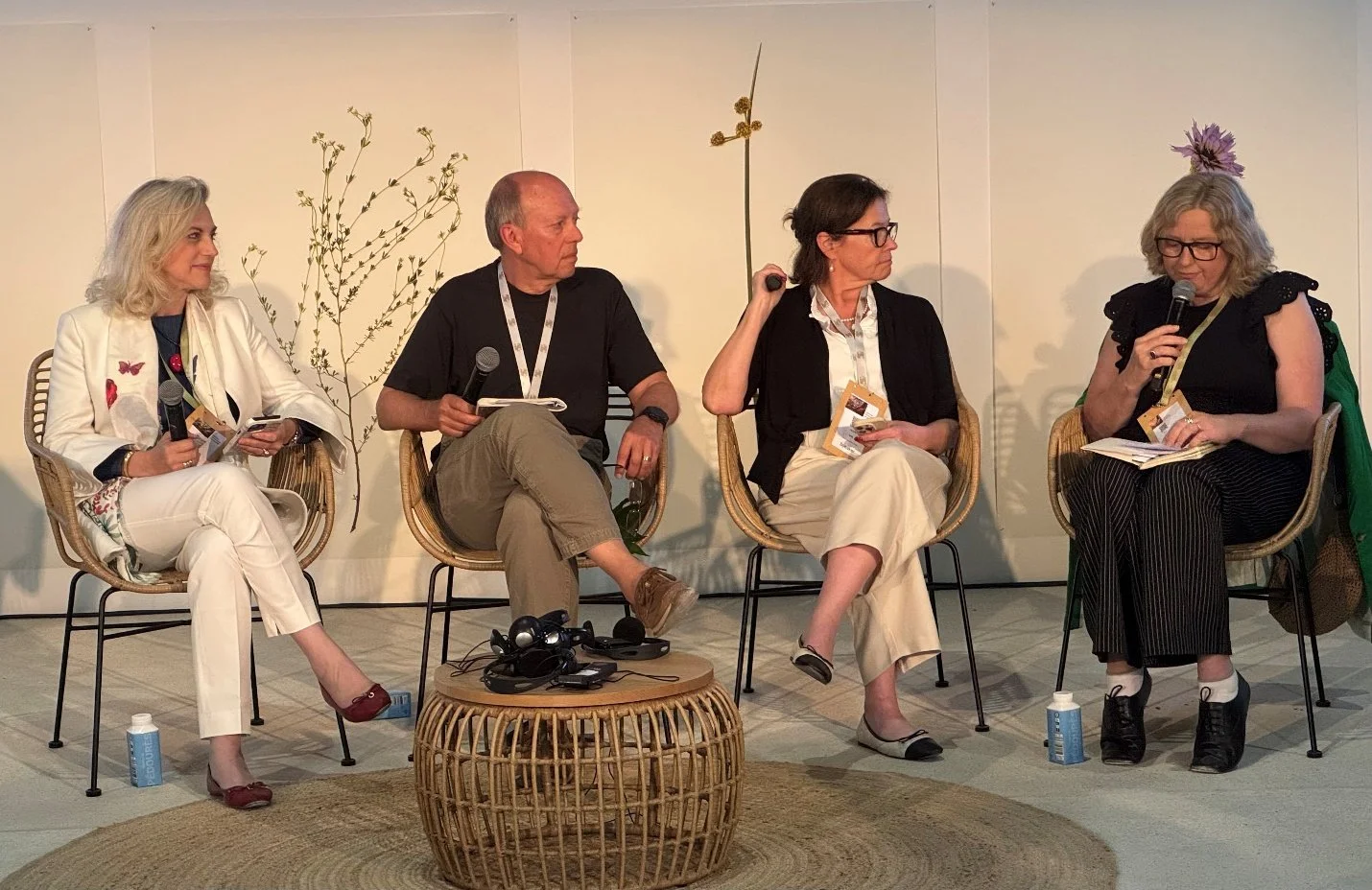
Biodiversity Panel with Nicole Rolet, Heleen Rabe, and Becky Sykes
The WLSF also enabled LVMH to showcase its work to regenerate vineyard ecosystems. Among the twenty-nine LVMH estates, Château Cheval Blanc stands out for its significant investment in agroforestry, adopting a contrarian approach by planting trees within the vine rows. The commitment to regeneration sometimes requires considerable short-term financial sacrifice. Champagne producer Maison Ruinart, another LVMH property, continues to use these methods despite a 20% decrease in yield, which has significantly affected its bottom line.
By extensively promoting the work of its subsidiaries in a luxury-brand communication style, the meeting at times felt more like advertising than an exchange of agricultural initiatives. Still, in a world filled with corporate greenwashing, LVMH appears more committed to creating a sustainable future than most. Antoine Arnault (the son of billionaire CEO Bernard Arnault, more on this later) summarized the company’s many efforts, including important partnerships with UNESCO to protect biodiversity and the World Wildlife Fund to preserve the Congo Basin rainforest.
Despite the festive atmosphere, the extraordinary opportunity to learn from more than 600 participants, and the honor of sharing Dodon’s experience on two panels, I came home curiously unsettled. Part of this feeling stemmed from the luxury branding, which clashed with the deadly serious subjects at hand. I need to get over my aversion to glitz. LVMH does it very well, and if some people are motivated to act by excessive showiness, then so be it.
But for those of us who came to Arles hopeful, the days there were a study in contradiction. We found ourselves caught between two truths: on one side, rooting for the genuine progress toward healthy, living ecosystems; on the other, the immense shortcomings of so many of these efforts, especially those that remain untouched. It is a tension that everyone working toward just and sustainable agricultural systems always feels.
What struck me, then, was not the meeting's communal effervescence, which it had in abundance, but its collective cognitive illusion. Most presentations concluded that we understood enough to adopt nature-based solutions to our environmental and agricultural problems. In this view, success depends not on a reciprocal relationship with nature but on the clever selection of the most appropriate cover crops and the precise timing of their termination. I kept returning to the same unease: the work is real and valuable, and yet so much of it seems to miss the point. How can we hold both truths at once—and honestly ask whether we are moving toward our shared goal?
Chemist Leslie Orgel must be turning in his grave. His second rule, that “evolution is cleverer than you are,” says it all. Embracing this concept requires us to change our relationship with nature, adopting humility and casting aside the delusion that humans are superior to the other eight billion species on the planet, free to do with them as we wish. It requires us to be part of, not in charge of, a holistic, self-regulating, resilient world.
Grasping evolution’s lessons requires openness, patience, and attention to what is happening around us. The solution to a cover crop problem will usually be in plain sight, either along the edge of a farm field or within it, not in a consultant’s cookbook of recommendations developed hundreds or even thousands of miles away. Grasses and forbs already adapted to the local ecosystem will dominate these areas if we encourage their growth. They will also adjust to changing seasons and conditions, the very definition of resilience.
Scaling regenerative successes was also at the forefront of most minds at the WLSF, but there were few novel insights. Many attendees and speakers, including the sponsors, represented large companies seeking to implement regenerative practices globally. Others sought to promote wider adoption of globally uniform certification schemes. Yet nature and evolution operate locally, often in multiple places at once, slowly spreading until they converge on one or more solutions. This is Rudolf Steiner’s central insight: knowledge that fits the farm is grown on the farm, not shipped to it.
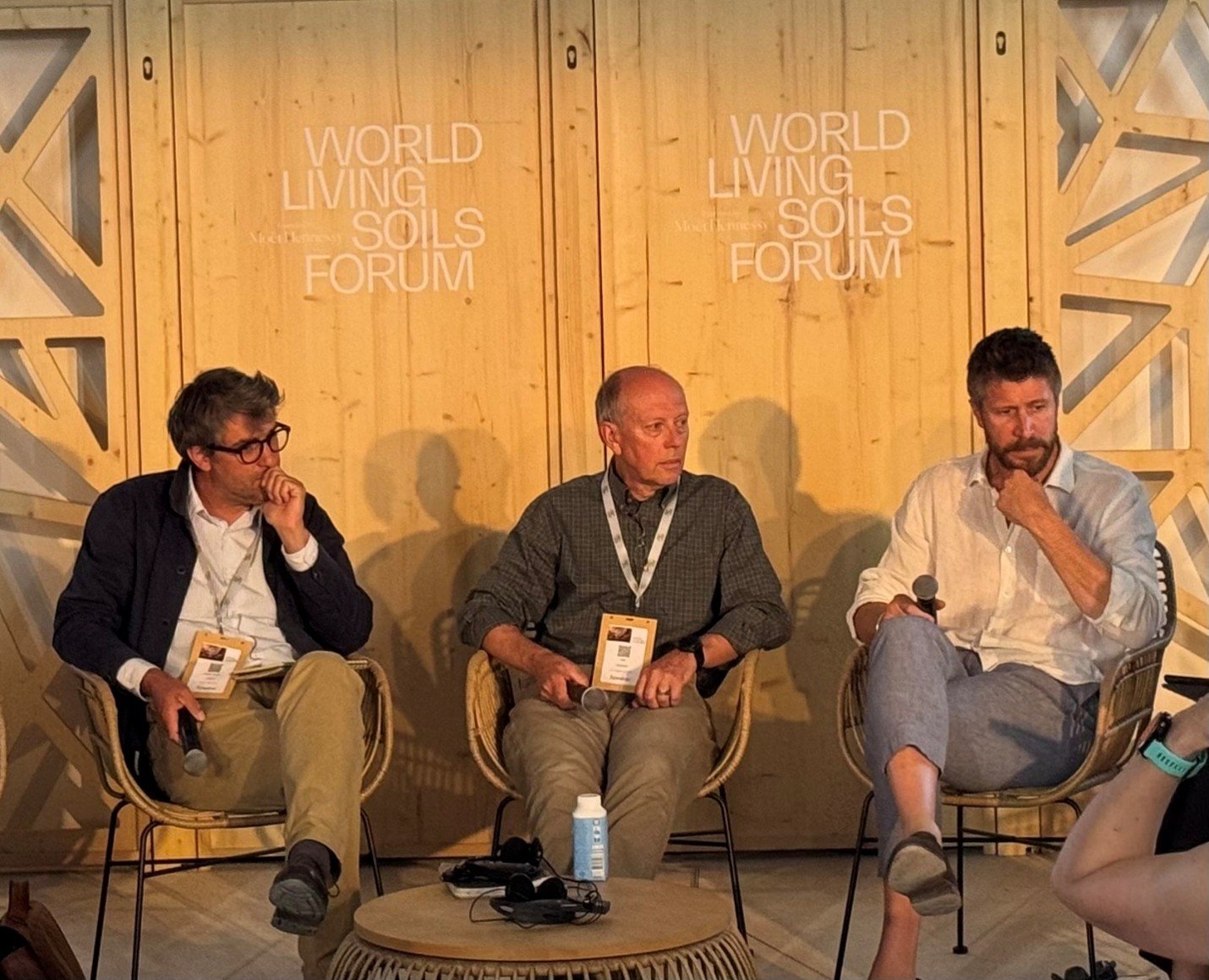
Agroforestry panel with Pierre-Olivier Clouet and Benedikt Bösel.
Social psychology deepens our understanding of why decentralized knowledge transfer is important. When systemic change is imposed from outside the community, it threatens identity, heightens uncertainty, and triggers resistance. Conversely, lasting transformation begins within individuals and then extends to communities. Implementing a global vision will require the hard work of many local projects, not global magic bullets.
Agroecology has a significant commitment to social justice, a principle that most practitioners extend to the growing regenerative agriculture movement. The WLSF focus on young farmers was both refreshing and disturbing. A few presentations, most notably by Benedikt Bösel, emphasized the need to make farming attractive – intellectually, socially, financially, and spiritually- to younger generations if the regenerative changes we seek are to become commonplace. Agroecology has always understood farming as a social practice as much as a technical one, and a movement that cannot welcome the next generation will not endure. No one, however, mentioned the role of large corporations, which frequently use their considerable market power to control the prices of farm inputs, labor, and products, thus suppressing the wages needed to support young families.
Nature doesn’t offer solutions to these entirely human challenges. Panels on financing, insurance, certification, and coalitions failed to offer solutions to the fundamental structural barriers that trap farmers in a system that pays only a third of the true costs of our food and shackles them to subsidy payments that leave no room for innovative practices that would sequester carbon dioxide, reduce eutrophication, cut chemical and plastic pollution, and improve product quality.
Widespread adoption of regenerative agriculture thus remains limited, in part due to corporate influence, aggressive marketing, and public policies that prioritize profits over public health, the environment, and social justice. LVMH and its luxury-brand peers have been criticized for low wages, exploitative business practices, and lack of transparency. I doubt the contrast between its ultra-high-net-worth CEO and migrant workers making less than five dollars for a 90-hour work week is the vision of a regenerative world the organizers intended. Still, it was in the WLSF background for many.
Although their visibility makes their moral shortcomings more apparent, worker exploitation isn’t confined to luxury brands. Modern agriculture in the United States traces its origins to policies that forcibly displaced indigenous peoples from their ancestral lands, expanded production by appropriating slave labor, and enriched itself under Jim Crow-era policies that drove Black families from their farmland, failings that extend to my own family. The problem is so pervasive that B-Lab, an organization that certifies companies based on their social and environmental performance, transparency, and accountability, doesn’t consider it foundational. Facing our weaknesses, individually and collectively, is the first step toward achieving a regenerative vision.
Life is complicated. Doing good for the environment doesn’t ensure we will treat our fellow humans with dignity, respect, and fairness. Yet how can we regenerate nature if we continue to exploit one another? I hope future editions of the WLSF will demonstrate that LVMH has used its power and influence to join with others to create a more equitable social contract with the rest of society. As the author and environmentalist Paul Hawken notes, “The promise of business is to increase the well-being of humankind through service, creative invention and ethical philosophy.”
The tension I felt in Arles will not resolve; it will travel with us. Our task is to welcome it—to embrace it as it widens into the full spectrum of human and natural experience—and to carry the community we are building toward deeper and more distant points of environmental and social justice. It will not be perfect, and it will never be quite enough. But we believe that traveling along this road, patiently and together, is the future we should seek.