
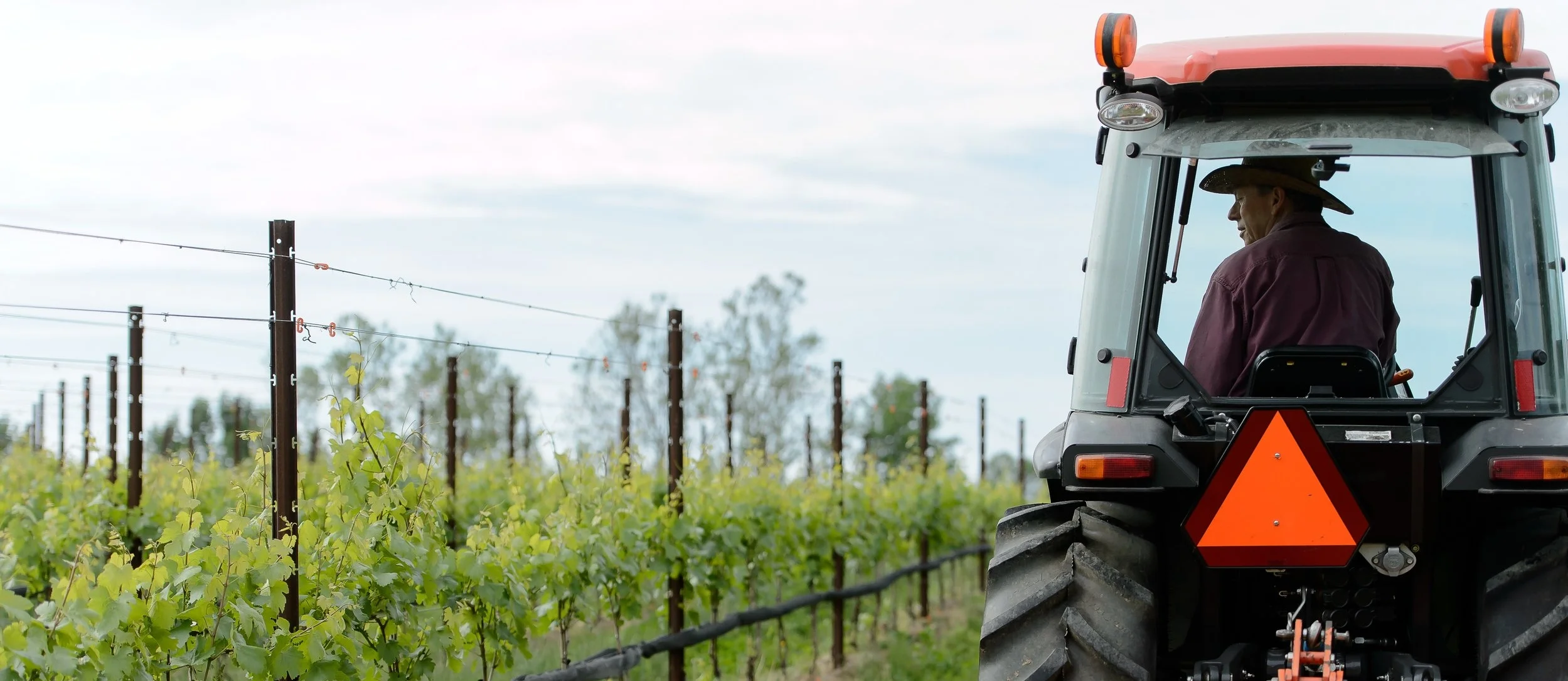
2013 Harvest Review
Harvest is over. The wines are pressed and aging in barrels. Careful attention to detail and patience have taken over where organized bedlam and urgency once reigned. It’s snowing as I write – a good time to reflect.
Harvest is over. The wines are pressed and aging in barrels. Careful attention to detail and patience have taken over where organized bedlam and urgency once reigned. It’s snowing as I write – a good time to reflect.
IMG_1083The weather, cool and wet most of the season, had turned perfect – hot days, coolish nights, and no rain – in mid-August. The downy mildew we had been battling all summer dried up. But as September progressed, the unusual features of the vintage became the dominant trend. The sugars jumped quickly, ranging from 23.5 degrees brix in block 21 to 25.5 in the Petit Verdot in block 23, and then didn’t move much. Then, on September 25, the acids started to drop quickly. It started with the Merlot in block 21 and went quickly across the vineyard over the next week. Because high acid levels protect the fruit from botrytis and other late season mildews, loss of acid is always a worrisome event. Heavy rain or even dew could mean the fruit will start to break down.
So we started picking – 3000 pounds of Merlot from block 21 and 1500 pounds of Cabernet Franc from block 22 on September 28. After the first few rows of Merlot, we had three teams working simultaneously. Under Mike’s steady hand, the pickers filled the lugs and sent them to the crush pad crew, led by my mother, where we weighed, destemmed, sorted, crushed, and moved the fruit to the tanks. Rocky and John were in the cellar, taking care of the routine monitoring, drawing a saignee for the Rose, and testing the must. The fruit was beautiful.
Tank 9 was filled with Merlot by lunch, when the pickers started sending the Cab Franc. In contrast to the Merlot, the yields were low, in part because we pulled out nearly 200 diseased vines last winter. To get an optimal fermentation temperature, we try to fill the containers, but even our small tanks are too big for 1,500 pounds. Based on his experience in Pomerol and Napa, Rocky suggested we pop the tops from some barrels and use these in place of tanks. Using tarps and space heaters, we were able to get the temperatures into the mid-80′s, and 4×4′s served as tracks for rolling the barrels to keep the caps moist. The results exceeded our expectations.
What began evenly, calmly, almost serenely, quickly turned to frenzy as the rest of the reds ripened – almost all at once – while a tropical storm emerged in the Caribbean and a cold front tracked from the west. Four acres of nearly ripe fruit and tropical weather on the way is recipe for winemaker anxiety. With the storms due Sunday evening, we decided to pick everything Saturday and crush Sunday, a strategy made possible by our cold fermentation room that doubles as a refrigeration area if need be. Leaving nothing to chance, we also chose Sunday for our blessing of the grapes ceremony.
The yields in the younger blocks were very low, the result of the very low vigor in this part of the vineyard, but like blocks 21 and 22, the quality was great. Added to the 1,600 pounds of Cabernet Sauvignon and 800 pounds of Petit Verdot, we had enough to fill one fermenter and a couple of more barrels, leaving only Cabernet Sauvignon block 25 to hang through the storm.
On Sunday, the crush pad hummed and the cellar buzzed with activity. In addition to the crush, we had pump-overs and nearly 20 active fermentations to manage. In the following weeks, we sniffed, tasted, listened, rolled, and pumped-over morning, noon, and night, literally. The goal during this period is to manage the “cap,” the mass of skins that is forced to the top of the fermentation by carbon dioxide produced during the fermentation. If the cap gets too wet or too dry, vinegar producing bacteria can take over before all the fruit and tannins are extracted. If this happens, the resulting wine will at best be pale and thin; at worst, it will be spoiled. Fortunately, we did our tasks well. Only block 25 disappointed. The rain lasted longer than predicted, resulting in botrytis and loss of about 75% of the crop.
And then it was time to press, again almost all at once. We were able to wait for the tannins to shift to the mid-palate, just where we want them, before pressing. On some days, we pressed three wines, each taking about 5 hours, carefully tasting each cycle to determine the best time to make the “press cuts” that separate the best fractions from the rest. The barrel fermentations produced such little volume that we decided to press these wines by hand, adding to the long days. (Rocky’s biceps are two inches bigger from all the cranking on the ratchet.) But somehow, all the wine got into a barrel, and now we wait, using all our senses to monitor the élevage until the wines are ready for bottle – in the spring for the Sauvignon Blanc and the Rose; the fall for the Chardonnay, and spring 2015 for the reds. The white wines are golden, round, lively. The red wines have deep color, wonderful fruit, and remarkable structure. We’re very excited about the vintage.
2013 Harvest Update
Harvest is what we work for. And now it’s in full swing. The Sauvignon Blanc and Chardonnay are in the cellar, settled, and the fermentations started. We started slow, a good warm up for the new cellar, with just 750 pounds from the third leaf SB in block 12. The fruit was very ripe, brix 23.8 for those who care about sugar levels, and very clean. Young vines always yield less fruit, but even we were surprised a few days later when the fourth leaf SB in block 11 produced 3000 pounds from less than a half acre. We’re fermenting those two lots separately, very slowly, but we’ll eventually bring them together to produce a delightful wine, with Block 11′s slightly less ripe fruit bringing SB’s characteristic aromatics to merge with fullness on the mid-palate contributed by Block 12. In the cellar, it’s remarkable to taste the emerging wine each day, spritzy and sweet, and complex with yeast as the fermentations get rolling.
Harvest is what we work for. And now it’s in full swing. The Sauvignon Blanc and Chardonnay are in the cellar, settled, and the fermentations started. We started slow, a good warm up for the new cellar, with just 750 pounds from the third leaf SB in block 12. The fruit was very ripe, brix 23.8 for those who care about sugar levels, and very clean. Young vines always yield less fruit, but even we were surprised a few days later when the fourth leaf SB in block 11 produced 3000 pounds from less than a half acre. We’re fermenting those two lots separately, very slowly, but we’ll eventually bring them together to produce a delightful wine, with Block 11′s slightly less ripe fruit bringing SB’s characteristic aromatics to merge with fullness on the mid-palate contributed by Block 12. In the cellar, it’s remarkable to taste the emerging wine each day, spritzy and sweet, and complex with yeast as the fermentations get rolling.
John and I walked the red blocks this morning. They handled last night’s rain well. The near perfect weather of the last few weeks left us in good shape. The Merlot skins are giving up plenty of color and their tannins are no longer bitter. The acids are dropping (pH about 3.45), and the seeds are passing through their “black tea” quality on the way to the walnut character that indicates they are fully ripened.
Harvesting the Merlot will start the real work in the cellar. We try to pick and sort on the same day, which means equal time in the vineyard and standing at the sorting table, and then doing chemistries, starting the cold soaks, and cleaning up. It makes for very long day. A few days later, we’ll start the pump-overs, three times a day to extract as much flavor as we can from the skins.
My favorite part about harvest is the picking. Working fast is important. The sugars start to deteriorate the moment the peduncle is cut. Hot days hasten the process. Keeping the fruit cool is the reason many growers in hot regions pick at night, but temperature must be balanced with other factors, especially the morning dew common in southern Maryland. The water dilutes the juice and thus the flavor. We’re lucky at Dodon, since the cellar is never more that a quarter mile from the fruit, allowing us to get it quickly into cooler temperatures.
Despite the pace of picking, time passes gently, calm before the coming frenzy of the cellar. Conversations come and go easily, usually starting with a discussion about the fruit and what we’re seeing, smelling, and tasting. How ripe is it? Is ripeness even on all parts of the bunches? Is there much rachis failure, a sign of some problem in May during bloom. Did any fruit get sun burned, indicating the need for more attention to leafing? Before long, though, we settle in, discussing families and events of the day and interests. New volunteers become part of the team in the course of a few panels. Sometimes we are just being – quiet, reflective, thankful – a moment distant from multitasking and multiple demands. We watch as empty lugs disappear with a steady rhythm that marks our progress, each filling with 30 pounds of fruit and then carried away.
We’re off to a great start.